If you are trying to grow your business online, you have probably asked this question:
Should I invest in SEO or Google Ads?
Both can help your business reach potential customers, but they work in very different ways.
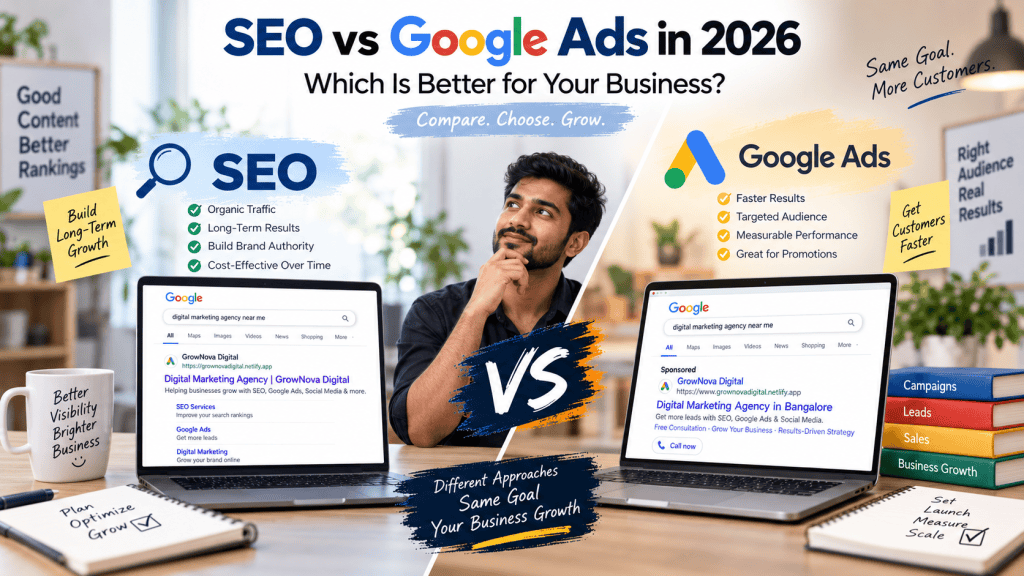
SEO focuses on improving your organic visibility in search engines. Google Ads allows you to pay for advertising placements to reach people searching for relevant products and services.
So which one is better?
The answer depends on your business goals, budget, competition, timeline, and customers.
In this guide, we’ll compare SEO and Google Ads and explain how you can decide which strategy is right for your business in 2026.
What Is SEO?
SEO stands for Search Engine Optimization.
It is the process of improving your website and online presence so search engines can understand your content and users can discover your business through relevant searches.
Google describes SEO as helping search engines understand your content and helping users find your site through search.
SEO can include:
- Keyword research
- Technical SEO
- On-page optimization
- Content creation
- Internal linking
- Local SEO
- Google Business Profile optimization
- Backlink building
- Website performance
- Search Console monitoring
For example, if you provide digital marketing services in Bangalore, you may want your website to appear for searches such as:
“digital marketing agency in Bangalore”
“SEO services in Bangalore”
“SEO consultant near me”
The objective is to earn visibility through organic search.
What Is Google Ads?
Google Ads is Google’s paid advertising platform.
Instead of waiting for your website to gain organic visibility, you can create advertising campaigns designed to reach potential customers through Google’s advertising network.
For example, a business selling a service could create a search campaign targeting relevant queries.
When someone searches for a relevant term, an eligible advertisement may appear in the advertising section of the search results.
Google Ads can be useful when a business wants to generate targeted traffic without waiting for organic SEO growth.
SEO vs Google Ads: The Main Difference
The simplest way to understand the difference is:
SEO = Earn organic visibility
Google Ads = Pay for advertising visibility
SEO generally requires continuous optimization and content development.
Google Ads requires advertising budget and campaign management.
Both require strategy.
Neither should be treated as a magic button that automatically generates customers.
SEO Advantages
1. Long-Term Growth
A well-optimized website can continue attracting organic visitors after the initial work has been completed.
This doesn’t mean SEO is completely passive.
Search results change, competitors improve, websites change, and content needs to be updated.
But the work can build a long-term organic asset for your business.
2. Builds Website Authority
Consistently publishing useful content and building a trustworthy online presence can help establish your business as a useful resource.
For example, an SEO agency can publish articles about:
- SEO
- Local SEO
- Google Business Profile
- Keyword research
- Technical SEO
- Content marketing
- Google Ads
This can help attract people at different stages of the buying journey.
3. Can Reduce Dependence on Paid Traffic
If your website generates consistent organic traffic, you may not need to rely entirely on advertising for every website visit.
Organic visibility can become another acquisition channel.
4. Helps Build Brand Visibility
Appearing repeatedly in relevant organic searches can help people become familiar with your brand.
Even when someone doesn’t click immediately, repeated visibility can contribute to brand awareness.
SEO Disadvantages
SEO also has limitations.
SEO Takes Time
SEO normally doesn’t produce guaranteed overnight results.
The timeline depends on factors such as:
- Competition
- Website authority
- Industry
- Target keywords
- Content quality
- Technical health
- Backlink profile
- Search intent
- Existing website performance
A new website competing for highly competitive keywords may need considerable time and effort.
SEO Requires Consistent Work
SEO isn’t a one-time task.
You may need to:
- Update content
- Fix technical issues
- Monitor rankings
- Analyze Search Console
- Improve pages
- Build authority
- Create new content
Google Ads Advantages
1. Faster Visibility
One of the biggest advantages of Google Ads is speed.
Once your campaign is properly configured and approved, your advertisements can start reaching potential customers without waiting for organic rankings to develop.
This can be particularly useful for:
- New businesses
- New products
- Time-sensitive offers
- Lead-generation campaigns
- Promotional campaigns
2. Target Specific Searches
Google Ads allows businesses to target relevant audiences and search terms.
For example, a local business may target people searching for a specific service in its target area.
This can make paid search useful when you have a clear customer and offer.
3. Easy to Measure
Advertising campaigns can provide data that helps you understand:
- Clicks
- Impressions
- Cost
- Conversions
- Search terms
- Conversion rates
- Campaign performance
This allows businesses to measure advertising performance and make adjustments.
4. Useful for Testing
Suppose you are unsure whether customers are interested in a particular service.
A carefully managed advertising campaign can help you collect data about demand, messaging, keywords, and conversion performance.
That information can also provide useful insights for your broader marketing strategy.
Google Ads Disadvantages
1. Requires Continuous Budget
Google Ads requires advertising spend.
If you stop running your campaigns, your paid search visibility can stop as well.
This is different from organic SEO, where previously earned rankings may continue generating traffic, although rankings are never guaranteed.
2. Poor Campaign Management Can Waste Money
Simply creating an advertisement doesn’t guarantee profitable results.
Poor keyword targeting, weak landing pages, irrelevant traffic, incorrect location targeting, or ineffective bidding can result in wasted budget.
3. Competition Can Increase Costs
Some industries have highly competitive advertising markets.
The cost of advertising can vary significantly depending on the industry, location, keyword, competition, and campaign settings.
SEO vs Google Ads Comparison
| Factor | SEO | Google Ads |
|---|---|---|
| Visibility | Organic | Paid |
| Initial speed | Usually slower | Usually faster |
| Long-term potential | High | Depends on continued spend |
| Budget | Investment in optimization | Advertising budget |
| Traffic after stopping | May continue | Paid traffic generally stops |
| Content requirement | Important | Important for landing pages |
| Local businesses | Very useful | Very useful |
| Measurement | Strong | Strong |
| Best for | Long-term growth | Faster targeted traffic |
| Main challenge | Time and competition | Cost and optimization |
Which Is Better for a New Business?
If you have just launched your business, you don’t necessarily have to choose only one.
A combination can often make sense.
For example:
Google Ads → Generate initial traffic and enquiries
SEO → Build long-term organic visibility
Content → Answer customer questions
Local SEO → Improve local discovery
Analytics → Measure results
This creates a more balanced digital marketing strategy.
Which Is Better for a Small Business?
For many small businesses, SEO can be valuable because it builds a long-term online presence.
However, if you need leads quickly, Google Ads may be useful.
Consider your situation.
Choose SEO If:
- You want long-term organic growth
- You are willing to invest time
- You want to build website authority
- You want consistent content visibility
- You want to reduce dependence on paid traffic
- You operate in a local market
Consider Google Ads If:
- You need traffic quickly
- You have a specific advertising budget
- You have a strong offer
- You want to test demand
- You need immediate lead-generation opportunities
- You can properly track conversions
Can SEO and Google Ads Work Together?
Yes.
In many cases, the strongest approach isn’t SEO versus Google Ads.
It is:
SEO + Google Ads.
For example, imagine a local digital marketing agency.
The company could use Google Ads to target high-intent searches such as:
“SEO agency near me”
At the same time, the company could build organic visibility through content targeting searches such as:
“How much does SEO cost for a small business?”
and:
“How does Local SEO work?”
The paid campaign focuses on immediate opportunities.
The SEO strategy builds long-term visibility.
Use SEO Data to Improve Google Ads
Your SEO research can provide useful information for paid campaigns.
For example, you may discover that users frequently search for a specific service.
That information can help you understand:
- Customer language
- Search intent
- Popular services
- Content opportunities
- Landing-page topics
Likewise, Google Ads data can reveal which search terms generate conversions.
Those insights can help inform your organic content strategy.
Use Google Ads Data to Improve Your SEO Strategy
Suppose a Google Ads campaign reveals that a particular keyword generates high-quality leads.
That may indicate that the topic has strong commercial intent.
You could then consider creating or improving an organic landing page around that service.
This creates a feedback loop:
Paid Search Data → Insights → SEO Content → Organic Visibility
Don’t Forget the Landing Page
Whether your visitor comes from SEO or Google Ads, your website still needs to convert them.
A good landing page should clearly communicate:
- What you offer
- Who you help
- Why your service is valuable
- What makes your business different
- How customers can contact you
Make the next step obvious.
Depending on your business, that might be:
Call Now
Get a Quote
Book a Consultation
Send an Enquiry
WhatsApp Us
Traffic alone isn’t the goal.
Relevant traffic that converts is the goal.
SEO, Google Ads and Local SEO
For businesses serving a specific geographic area, Local SEO can be combined with both strategies.
For example:
Google Business Profile + Local SEO + Website SEO + Google Ads
This can help a business reach customers through multiple search channels.
A local restaurant might use Local SEO to improve its organic visibility while running paid campaigns for specific promotions.
A service company might use Google Ads to generate immediate enquiries while building organic rankings for its main services.
What About AI Search in 2026?
Search is continuing to evolve.
Google now provides guidance for optimizing websites for generative AI features such as AI Overviews and AI Mode.
Importantly, Google says that the foundational SEO practices used for traditional Search remain relevant to generative AI search experiences.
That means businesses should continue focusing on:
- Useful content
- Clear website structure
- Technical SEO
- Original information
- Trust
- Relevant expertise
- Good user experience
You don’t need to abandon SEO because search is becoming more AI-driven.
Instead, build a strong website that can be understood by both search engines and people.
A Practical Strategy for 2026
If you are a small business, you can start with this simple approach:
Phase 1: Build the Foundation
- Create a professional website
- Optimize important pages
- Set up Google Search Console
- Set up analytics
- Create or optimize your Google Business Profile
Phase 2: Build Organic Visibility
- Research keywords
- Create useful content
- Improve service pages
- Build internal links
- Earn relevant backlinks
- Improve technical SEO
Phase 3: Add Paid Advertising
- Identify high-intent keywords
- Create focused campaigns
- Build relevant landing pages
- Track conversions
- Review campaign performance
- Optimize regularly
Phase 4: Measure Business Results
Track:
- Website traffic
- Leads
- Calls
- Enquiries
- Conversion rate
- Cost per lead
- Organic traffic
- Paid traffic
- Revenue where possible
Don’t judge your entire strategy by rankings or clicks alone.
Measure whether marketing is contributing to business growth.
Common Mistakes Businesses Make
Mistake 1: Expecting Instant SEO Results
SEO takes time and requires consistent improvement.
Mistake 2: Running Google Ads Without Conversion Tracking
If you don’t know which campaigns generate leads, it becomes difficult to make informed decisions.
Mistake 3: Sending Every Ad to the Homepage
A dedicated, relevant landing page can provide a better experience for visitors.
Mistake 4: Ignoring Organic Search
Only running paid campaigns can leave you dependent on advertising spend.
Mistake 5: Focusing Only on Traffic
Thousands of visitors are not useful if they don’t match your target customer.
Final Verdict: SEO or Google Ads?
There isn’t one universal answer.
The right choice depends on your business.
If you want long-term organic visibility, SEO should be part of your strategy.
If you need faster targeted traffic, Google Ads can be valuable.
If you want to build a stronger overall acquisition system, consider using both together.
Think of it this way:
SEO builds the foundation.
Google Ads accelerates visibility.
Content builds trust.
Local SEO captures nearby customers.
Conversion optimization turns visitors into leads.
The best digital marketing strategy is not about choosing the trendiest channel.
It is about choosing the channels that match your customers, goals, budget, and business model.
Final Takeaway
In 2026, businesses shouldn’t think of SEO and Google Ads as enemies.
They are two different tools that can work together.
Build a strong website.
Create useful content.
Optimize for relevant searches.
Use Local SEO if your business serves a local market.
Use Google Ads when paid visibility makes business sense.
Then measure the results and improve your strategy based on real data.
Don’t just chase clicks. Build a system that turns search visibility into real customers.
About the Author
Mugesh Sivakumar is an SEO and Digital Marketing Specialist helping startups and local businesses improve their online visibility through SEO, Local SEO, Google Ads, content marketing, and digital marketing strategies.
His work focuses on technical SEO, keyword research, on-page optimization, content strategy, local search visibility, backlink building, Google Ads, and performance analysis.
Want to improve your website’s visibility and generate more leads?
Start by understanding where your customers are searching and build a digital marketing strategy around those opportunities.
 GrowNovaDigital | SEO & Digital Marketing Blog
Leave a comment