
Published by Mugesh Sivakumar | SEO & Digital Marketing Specialist
When people need a nearby service, restaurant, shop, agency, or professional, one of the first things they often do is search on Google.
For example:
- SEO agency near me
- Digital marketing agency in Bangalore
- Best restaurant near me
- AC service near me
- Dental clinic near me
- Web design company in Bangalore
These searches have something in common: local intent.
If your business serves customers in a specific city, area, or region, Local SEO can help your business become more visible when potential customers search for your products or services.
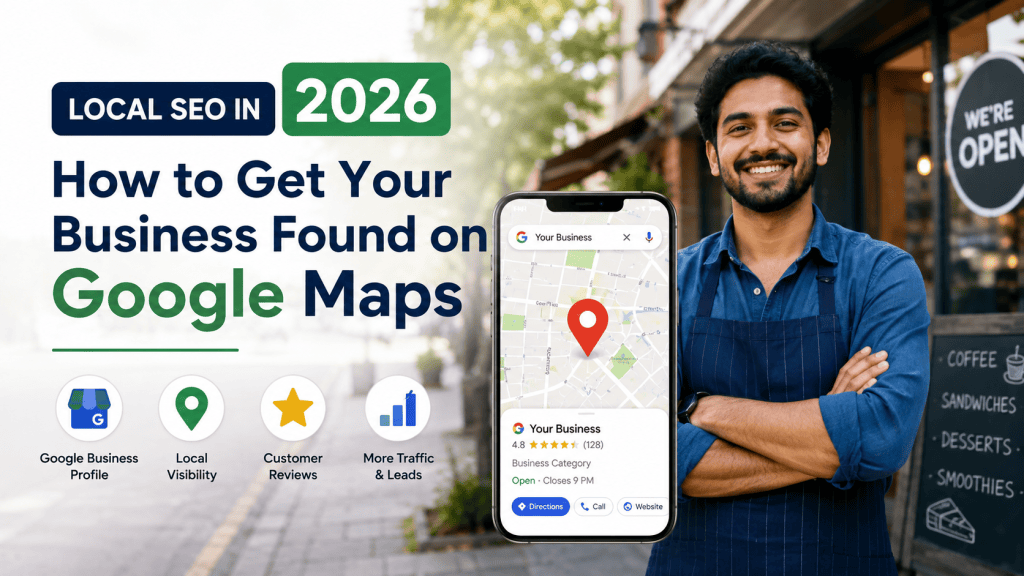
In this guide, we will explain what Local SEO is, why it matters in 2026, and the practical steps small businesses can take to improve their local visibility.
What Is Local SEO?
Local SEO is the process of improving your online presence so that your business can appear more prominently for searches related to a specific geographic location.
For example, if you operate a digital marketing company in Bangalore, you may want to appear for searches such as:
“SEO services in Bangalore”
or
“digital marketing agency near me.”
Local SEO focuses on helping search engines understand:
- What your business does
- Where your business operates
- Which products or services you provide
- How customers can contact you
- Whether your business is relevant to a local search
The goal is simple:
Help local customers discover your business when they are looking for what you offer.
Why Local SEO Is Important for Small Businesses
Local SEO can be especially valuable for businesses that depend on customers from a particular location.
Examples include:
- Restaurants
- Salons
- Clinics
- Real estate businesses
- Digital marketing agencies
- Repair services
- Hotels
- Retail stores
- Educational institutions
- Professional services
- Home service businesses
A customer searching for “plumber near me” is already looking for a solution.
Being visible at that moment can create an opportunity for a phone call, website visit, enquiry, direction request, or purchase.
1. Create and Optimize Your Google Business Profile
One of the most important foundations of Local SEO is your Google Business Profile.
Your profile should contain accurate and complete information about your business.
Make sure you provide:
- Correct business name
- Primary business category
- Relevant secondary categories
- Address or service area
- Phone number
- Website
- Business hours
- Business description
- Business services
- Business products
- High-quality photos
Keep your information accurate and consistent.
If your business details change, update them across your important online profiles as well.
2. Choose the Right Business Category
Your primary business category helps Google understand what your business does.
For example, a business offering SEO services should choose the category that most accurately represents its primary business activity.
Do not select unrelated categories simply because you think they might generate more visibility.
Your category should accurately represent the real business.
3. Keep Your Business Information Consistent
Your business information should be consistent across your website and relevant online directories.
Important details include:
Name
Address
Phone number
Website
This information is sometimes referred to as NAP information.
Inconsistent business information can create confusion for customers and search engines.
For example, if your website shows one phone number while multiple important business listings show another, it is worth correcting the inconsistency.
4. Get Genuine Customer Reviews
Reviews are an important part of a local business’s online reputation.
After providing a good product or service, you can encourage genuine customers to leave honest feedback about their experience.
Good review practices include:
- Ask real customers for feedback
- Make it easy for customers to find your review profile
- Respond professionally
- Thank customers for positive reviews
- Respond constructively to negative feedback
- Never create fake reviews
The goal should be to build genuine customer trust.
A business with a strong reputation can make a better impression on potential customers who discover it through Google.
5. Add High-Quality Photos
Photos can help customers understand your business before they contact you.
Depending on your business, consider adding:
- Business exterior
- Interior
- Team photos
- Products
- Services
- Work completed
- Office
- Restaurant or store
- Before-and-after examples where appropriate
Keep your images clear, authentic, and relevant.
Avoid uploading random stock images that do not represent your actual business.
6. Optimize Your Website for Local Searches
Your website should clearly communicate your service and location.
For example, if you provide SEO services in Bangalore, your website should naturally explain:
- What SEO services you provide
- Who you help
- Where you provide services
- Your areas of expertise
- How customers can contact you
You can optimize important website elements such as:
- Page title
- Meta description
- H1 heading
- Service content
- Internal links
- Image alt text
- Contact information
- Location information
- Structured data where appropriate
Do not repeatedly insert the city name into every sentence.
Write naturally for users first.
7. Create Useful Local Content
Local content can help demonstrate your relevance to a particular audience.
For example, a digital marketing agency could publish:
- SEO for Small Businesses in Bangalore
- Local SEO Guide for Bangalore Businesses
- How Restaurants Can Get More Customers from Google
- Google Business Profile Tips for Local Businesses
- Digital Marketing Strategies for Startups
The content should provide useful information rather than simply repeating location keywords.
8. Build Relevant Local Citations
A local citation is a mention of your business information on another website or directory.
Depending on your industry and location, relevant sources can include:
- Business directories
- Industry directories
- Local business websites
- Professional associations
- Chamber of commerce websites
- Local publications
- Industry-specific platforms
Quality is more important than quantity.
You do not need to submit your business to hundreds of low-quality directories.
Focus on websites that are relevant, legitimate, and useful to your customers.
9. Build Relevant Backlinks
Backlinks can support your overall SEO strategy.
For Local SEO, relevant local links can be particularly useful.
For example, a Bangalore business might earn links through:
- Local publications
- Business organizations
- Industry associations
- Local events
- Partnerships
- Community initiatives
- Useful local resources
A relevant, genuine mention can be more valuable than a large number of unrelated links.
10. Make Your Website Mobile-Friendly
Many local searches happen when people are away from their computers.
A potential customer may search for your business while:
- Travelling
- Shopping
- Looking for a restaurant
- Visiting a new area
- Looking for an emergency service
Your website should therefore work properly on smartphones.
Check:
- Mobile layout
- Font size
- Buttons
- Navigation
- Contact forms
- Page loading
- Images
- WhatsApp or call buttons
Make it easy for visitors to take the next step.
11. Improve Website Speed
A slow website can create a poor user experience.
Regularly check your website performance and look for opportunities to improve:
- Image sizes
- JavaScript
- CSS
- Hosting performance
- Caching
- Unnecessary plugins
- Third-party scripts
A faster website can provide a better experience for users, particularly on mobile connections.
12. Use Search Console to Understand Local Opportunities
Google Search Console can help you understand how people discover your website through Google Search.
Look at:
- Search queries
- Impressions
- Clicks
- Average position
- Pages receiving traffic
You may discover that your website is already appearing for local keywords you were not specifically targeting.
Those keywords can provide ideas for improving existing pages or creating new content.
13. Create Dedicated Location Pages Only When Useful
Businesses operating in multiple locations may consider creating location-specific pages.
For example:
- SEO Services in Bangalore
- SEO Services in Chennai
- SEO Services in Hyderabad
But each page should provide genuinely useful information for that location.
Simply changing the city name on the same page and publishing dozens of nearly identical pages does not create a strong local SEO strategy.
Each location page should offer unique value where appropriate.
14. Track Local SEO Results
SEO should be measured.
Some useful metrics include:
- Organic traffic
- Search impressions
- Search clicks
- Local keyword visibility
- Google Business Profile interactions
- Phone calls
- Website visits
- Direction requests
- Enquiries
- Leads
- Conversions
Do not focus only on rankings.
The purpose of Local SEO is to help generate real business opportunities.
Common Local SEO Mistakes
Using Fake Reviews
Fake reviews can damage trust and create serious reputation problems.
Keyword Stuffing
Adding the same location keyword repeatedly makes content unnatural.
Creating Hundreds of Duplicate Location Pages
Location pages should provide genuine value.
Ignoring Reviews
Reviews are part of your online reputation. Respond professionally and consistently.
Using Incorrect Business Information
Keep your important business information accurate across your online presence.
Buying Low-Quality Backlinks
Avoid shortcuts that can create an unnatural backlink profile.
Ignoring Mobile Users
A large portion of local customers may discover businesses from mobile devices.
A Simple Local SEO Checklist
If you are a small business owner, start with this checklist:
☐ Create or claim your Google Business Profile
☐ Choose the correct business category
☐ Complete your business information
☐ Add your website
☐ Add high-quality business photos
☐ Keep business information consistent
☐ Collect genuine customer reviews
☐ Respond to customer reviews
☐ Optimize your main website pages
☐ Create useful local content
☐ Build relevant local citations
☐ Earn relevant backlinks
☐ Check mobile usability
☐ Monitor website performance
☐ Track Search Console data
☐ Measure enquiries and leads
Final Thoughts
Local SEO is not about simply adding your city name to a website.
It is about building a trustworthy and relevant online presence that helps search engines and customers understand your business.
For small businesses, the fundamentals are often the most important:
Accurate business information + a strong Google Business Profile + useful website content + genuine reviews + relevant links + a good customer experience.
Start with the basics, measure your results, and improve consistently.
Your next customer could already be searching for your service on Google.
The question is:
Will they find your business?
About the Author
Mugesh Sivakumar is an SEO and Digital Marketing Specialist helping startups and local businesses improve their online visibility through SEO, Local SEO, content marketing, Google Ads, Meta Ads, and digital marketing strategies.
His work focuses on practical SEO strategies including technical SEO, on-page optimization, keyword research, content optimization, local search visibility, backlink building, and performance analysis.
Need help improving your local visibility?
A professional Local SEO audit can help identify opportunities to improve your website, Google Business Profile, local presence, and customer acquisition strategy.
 GrowNovaDigital | SEO & Digital Marketing Blog
Leave a comment