Why Your Website Is Not Ranking on Google: A Complete SEO Troubleshooting Guide
Discover why your website may not be ranking on Google and learn how to troubleshoot indexing, technical SEO, search intent, content, internal linking, local SEO, backlinks and other common ranking issues.
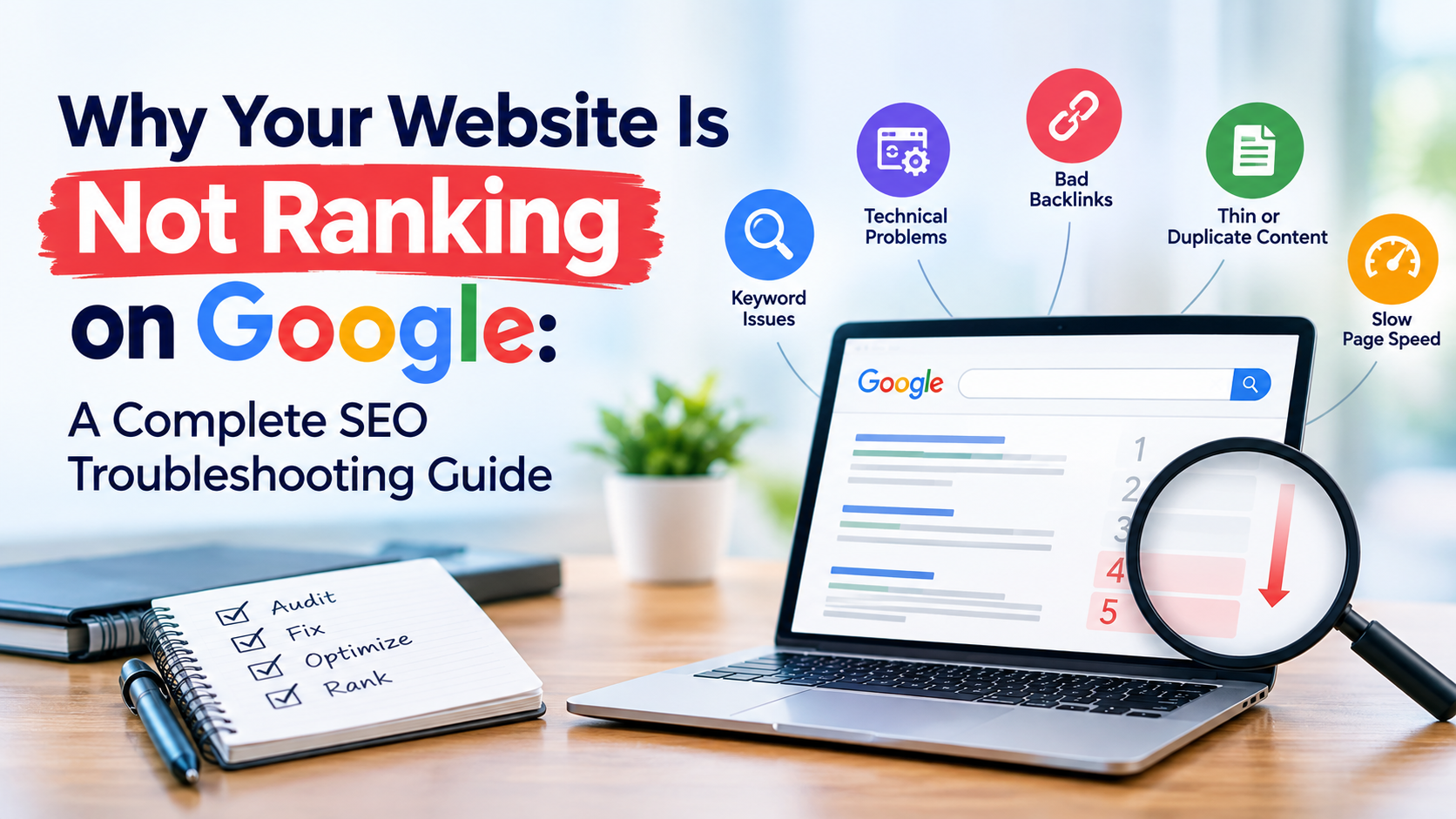
You built a website.
You added your services.
You published content.
You may even have added keywords, installed an SEO plugin, and submitted your sitemap.
But when you search Google for the services you offer, your website still doesn't appear where you expected.
Why?
The answer is usually not one single SEO problem.
A website can struggle in Google Search because of technical issues, poor search intent alignment, weak content, indexing problems, poor internal linking, lack of authority, local SEO gaps, or simply because the website has not yet built enough relevance for the searches it wants to rank for.
SEO is not about adding a few keywords and waiting for Google to rank the website.
It is a process of making a website discoverable, understandable, relevant, trustworthy, and useful to the people searching for it.
This guide explains the major areas you should investigate when your website is not ranking.
1. First Ask: Is Google Able to Find and Index Your Website?
Before worrying about rankings, determine whether Google can actually access and index your important pages.
A page cannot generate organic search visibility if Google is unable to properly discover or index it.
Google Search Console provides tools for checking how Google sees individual URLs and monitoring indexing and search performance.
Things to check
- Is the page returning a normal HTTP status?
- Is the page blocked by robots.txt?
- Does the page contain a
noindexdirective? - Is the page accessible without login?
- Is the URL included in your XML sitemap?
- Are important pages linked internally?
- Are there crawl errors?
- Is Google selecting a different canonical URL?
A common mistake
Some website owners immediately start changing titles and keywords when the real problem is that the important page is not properly indexed.
Always diagnose indexing before trying to improve rankings.
2. Check Google Search Console Before Making SEO Changes
Google Search Console can tell you much more than whether your website has traffic.
Look at:
- Total clicks
- Total impressions
- Average position
- Queries
- Top pages
- Countries
- Devices
- Indexing status
- Page experience
- Core Web Vitals
The search queries are particularly useful.
For example, you may discover that your page is already appearing for searches you never specifically targeted.
That gives you valuable information about how Google currently understands your page.
Instead of guessing what to optimize, you can use actual search data to identify opportunities.
3. Your Keyword May Be Wrong
One of the biggest SEO mistakes is choosing keywords based only on search volume.
A keyword can have thousands of searches and still be a poor target for your business.
Consider these searches:
"What is SEO?"
"SEO services in Bangalore"
"SEO agency for ecommerce website"
They are all related to SEO.
But the search intent is different.
The first person may be learning.
The second may be looking for a service provider.
The third may be comparing specialized solutions.
Your page needs to match the reason behind the search.
Think About Search Intent
A useful framework is:
Informational Intent
The person wants to learn something.
Examples:
- What is technical SEO?
- How does Google indexing work?
- What is local SEO?
Commercial Investigation
The person is researching options.
Examples:
- Best SEO services for small businesses
- SEO agency pricing
- Technical SEO consultant
Transactional Intent
The person is closer to taking action.
Examples:
- Hire SEO consultant
- SEO services Bangalore
- Local SEO agency near me
Navigational Intent
The person is trying to find a specific website or business.
Your content strategy should account for these different journeys.
4. Your Page May Be Targeting Too Many Keywords
Another common problem is trying to make one page rank for everything.
For example, a single service page might attempt to target:
- SEO services
- Google Ads
- Social media marketing
- Web development
- Content marketing
- Email marketing
- Branding
- Ecommerce
- Digital marketing
This can make the page unfocused.
Instead, create a logical website structure.
For example:
Digital Marketing
→ SEO Services
→ Google Ads
→ Local SEO
→ Ecommerce SEO
→ Technical SEO
→ Web Development
Each important service can then have a dedicated page that clearly explains the topic and satisfies its specific search intent.
5. Your Content May Not Actually Answer the Searcher's Question
Adding 2,000 words to a page does not automatically make it better.
Long content can still be weak.
Ask:
Does this page answer the user's actual question?
For every important page, consider:
- What problem does the visitor have?
- What information are they looking for?
- What decision are they trying to make?
- What questions will they have next?
- What evidence or examples would help?
- What should they do after reading?
Useful content should be created for people first.
Search optimization should support the content—not replace its usefulness.
6. Your Title and Heading Structure Matter
Your title is one of the first things users see in search results.
A weak title might be:
Home | ABC Company
A clearer title might communicate:
SEO Services in Bangalore | Technical & Local SEO
The same principle applies to your headings.
Your page should have a logical structure:
H1 → Main topic
H2 → Major sections
H3 → Supporting topics
Don't create headings simply to insert keywords.
Use them to make the page easier to understand and navigate.
7. Improve Internal Linking
Internal links are often overlooked.
Imagine you publish an excellent article about:
"How to Improve Google Search Rankings"
That article could naturally link to:
- Technical SEO
- Local SEO
- SEO Audit
- Keyword Research
- On-Page SEO
- Google Search Console
- Related service pages
This creates relationships between your content.
It also helps visitors discover additional useful information.
Websites should have accessible links so important pages can be discovered through crawling.
8. Check Your Website Architecture
A website can have excellent content and still have structural problems.
Look at:
- Navigation
- URL structure
- Categories
- Breadcrumbs
- Internal links
- Orphan pages
- Duplicate pages
- Redirects
- Canonical URLs
- XML sitemap
For example, if an important service page is several clicks away from the main navigation and has almost no internal links pointing to it, it may not receive the same level of visibility as well-connected pages.
Your website architecture should make sense to both users and search engines.
9. Watch Out for Duplicate and Similar Pages
If your website has multiple URLs containing substantially similar content, Google may need to determine which URL represents the primary version.
This is where canonicalization becomes important.
Common causes include:
- HTTP and HTTPS versions
- www and non-www versions
- URL parameters
- Duplicate product pages
- Multiple category URLs
- Similar location pages
- CMS-generated URLs
Don't create multiple nearly identical pages simply because you want to target slightly different keywords.
10. Technical SEO Is More Than Page Speed
Many people think technical SEO means only improving loading speed.
Technical SEO is much broader.
It can include:
Crawlability
Can search engines access important pages?
Indexability
Can eligible pages be included in Google's index?
Website Architecture
Can users and crawlers easily understand the site structure?
Canonicalization
Does Google know which version of a page should be treated as primary?
Redirects
Are old or changed URLs handled correctly?
Structured Data
Does your markup accurately describe eligible content?
JavaScript SEO
Can important content and links be discovered when JavaScript is involved?
Core Web Vitals
Does the website provide a good page experience?
Mobile Experience
Does the website work properly across mobile devices?
These areas should be checked systematically rather than randomly.
11. Structured Data Can Help Google Understand Your Content
Structured data provides machine-readable information about the content of a page.
Depending on the content and eligibility requirements, websites can use supported structured data types for things such as:
- Articles
- Products
- Organizations
- Local businesses
- Events
- Breadcrumbs
- FAQs in applicable contexts
Structured data can help search engines understand page content and may make pages eligible for certain search appearances when requirements are met.
But structured data is not a magic ranking button.
Adding schema does not guarantee a rich result.
The markup should accurately represent the visible page content and follow applicable search engine guidelines.
12. Local Businesses Need Local SEO
If your business serves a specific city or region, traditional SEO alone may not be enough.
A local business should consider:
- Google Business Profile
- Accurate business information
- Local landing pages
- Local search intent
- Reviews
- Relevant citations
- Location-specific content
- Local business structured data
- Consistent business information
- Local competitor research
For example, someone searching:
"SEO services in Bangalore"
has a different intent from someone searching:
"SEO services"
A business targeting Bangalore should build its website and local presence around the actual geographic market it serves.
13. Don't Ignore Your Competitors
Competitor analysis doesn't mean copying another website.
Instead, investigate:
- Which topics do they cover?
- Which services have dedicated pages?
- What questions do their pages answer?
- How is their website structured?
- Which pages appear for important searches?
- What content is missing from your website?
- What customer concerns do they address?
- Where are there opportunities to provide better information?
The objective is to understand the search landscape.
Then build something genuinely useful.
14. Backlinks Still Need to Be Relevant
Not every backlink is valuable.
Buying large quantities of unrelated links can create risk rather than building meaningful authority.
Instead, think about:
Relevance + Quality + Context + Trust
Potential opportunities can include:
- Industry publications
- Relevant directories
- Digital PR
- Expert contributions
- Partnerships
- Genuine brand mentions
- Resource pages
- Relevant editorial links
The goal should not simply be:
"How many backlinks can we get?"
A better question is:
"Which websites and communities are relevant to our business and audience?"
15. Don't Publish Content Just to Increase Word Count
Publishing 50 weak articles is not necessarily better than publishing 10 genuinely useful resources.
Before publishing an article, ask:
Does it solve a real problem?
Does it provide something useful?
Is the information accurate?
Does it demonstrate actual expertise?
Does it answer related questions?
Is the article easy to read?
Does it naturally connect to relevant pages?
Is there a reason for someone to bookmark or share it?
A strong content strategy is based on usefulness and relevance—not publishing volume alone.
16. AI Can Help With SEO — But It Is Not the SEO Strategy
AI tools can be useful for:
- Research assistance
- Content outlines
- Topic clustering
- Data analysis
- Identifying potential technical issues
- Summarizing Search Console data
- Finding content gaps
- Generating ideas
- Organizing large datasets
But there is an important distinction.
AI can assist the SEO process.
It does not automatically understand your entire business, customers, competitors, technical infrastructure, conversion process, and search landscape.
A tool can identify a possible problem.
Someone still needs to determine:
Is this actually a problem?
How important is it?
What caused it?
What should be changed?
Could the change create another problem?
Did the change improve the business outcome?
That is why good SEO combines data, technical knowledge, strategy, content quality and continuous testing.
17. SEO Rankings Are Not the Only KPI
Ranking position is useful, but it isn't the entire goal.
A website can rank for hundreds of keywords and still generate very few customers.
Track metrics such as:
- Organic impressions
- Organic clicks
- Search queries
- Keyword visibility
- Organic traffic
- Qualified enquiries
- Leads
- Sales
- Conversion rate
- Local visibility
- Indexed pages
- Technical health
The important question is:
Is organic search contributing to the business?
18. What Should You Do If Your Website Is Not Ranking?
Don't change everything at once.
Use a structured process.
Step 1 — Crawl the Website
Identify technical and structural problems.
Step 2 — Check Indexing
Use Google Search Console to determine whether important pages are indexed.
Step 3 — Analyze Search Queries
Understand what Google is already associating with your pages.
Step 4 — Research Search Intent
Determine what users actually want from each important query.
Step 5 — Map Keywords to Pages
Make sure important search terms have the right landing pages.
Step 6 — Improve Important Pages
Work on titles, headings, content, internal links, images and conversion elements.
Step 7 — Fix Technical Issues
Resolve crawlability, indexation, canonical, redirect, sitemap and other relevant technical problems.
Step 8 — Build Topical Authority
Create useful supporting content around important topics.
Step 9 — Improve Local Visibility
If your business serves a geographic market, strengthen your local presence.
Step 10 — Measure and Iterate
Compare performance over time and continue improving.
SEO Is a Process, Not a One-Time Fix
One of the biggest misconceptions about SEO is that there is a single checklist that guarantees rankings.
There isn't.
Search engines continuously process websites, content, links and other signals.
Your competitors are also changing their websites.
Your customers' searches change.
Your products and services change.
Your market changes.
That means SEO should be treated as an ongoing process of:
Research → Audit → Strategy → Optimization → Authority → Measurement → Improvement
The objective isn't simply to make a website "SEO-friendly."
The objective is to build a website that is:
Easy to discover.
Easy to understand.
Relevant to the search.
Useful to visitors.
Technically accessible.
Trustworthy.
Designed to convert.
Need Help Finding Why Your Website Isn't Ranking?
If you've already tried SEO plugins, keyword optimization, AI tools or content publishing but your website still isn't generating the organic visibility you expect, the next step should be diagnosis—not more random changes.
At GrowNovaDigital, we provide SEO services focused on identifying the actual problems affecting your website and building a practical optimization roadmap.
Our SEO work can include:
- Technical SEO Audits
- Crawlability & Indexation Analysis
- Keyword Research & Search Intent Mapping
- On-Page SEO
- Local SEO
- Google Business Profile Optimization
- Internal Linking
- Content Gap Analysis
- Competitor SEO Analysis
- Off-Page SEO & Relevant Link Building
- Google Search Console Analysis
- Core Web Vitals
- Structured Data
- Ecommerce SEO
- AI SEO & Answer Engine Optimization
- SEO Performance Monitoring
Our approach is simple:
Find the problem → Understand the cause → Prioritize the opportunity → Implement the fix → Measure the result → Improve continuously.
If you want to understand what is actually holding your website back in Google Search, explore our SEO services:
GrowNovaDigital SEO Services