Why Your Website Is Not Ranking on Google in 2026: 15 SEO Problems to Fix
Discover 15 common SEO problems that can prevent your website from ranking on Google in 2026, including indexing, search intent, technical SEO, content, internal linking, authority, local SEO and measurement issues.
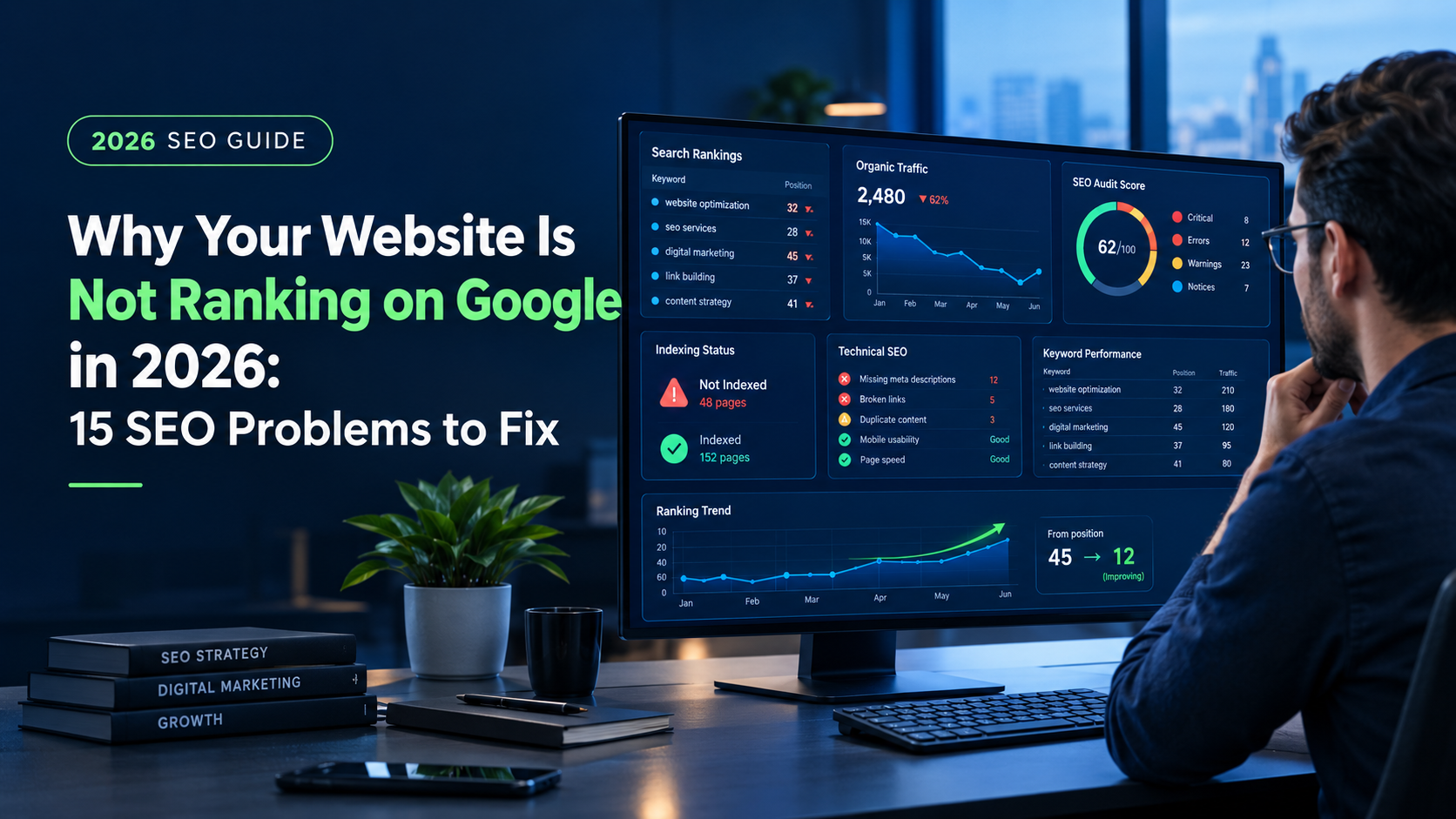
You published your website. You created pages and blog posts. You added keywords, submitted your sitemap, and waited for Google to rank your business.
But nothing seems to happen.
Your website may appear for your brand name, but important commercial keywords are nowhere near the first page. Some pages may be indexed but receive almost no impressions. Others may not appear in Google at all.
This situation is common.
The problem is that ranking on Google is not controlled by one SEO technique. A website can have excellent content and still struggle because of technical SEO problems. Another website may have strong technical foundations but fail because it does not satisfy search intent. A third website may have good pages but lack enough authority and relevance compared with competing sites.
In 2026, successful SEO requires a complete system that connects technical SEO, content quality, search intent, internal linking, topical relevance, authority, local SEO, user experience and ongoing measurement.
This guide explains 15 common reasons why websites are not ranking on Google and what you can do to fix them.
1. Your Website May Not Be Properly Indexed
Before asking why a page is ranking at position 50, first ask a more basic question:
Is Google actually indexing the page?
A page cannot generate organic visibility if Google has not included it in its search index.
Indexing and ranking are two different processes.
A page can be:
- Crawled but not indexed
- Indexed but not ranking well
- Ranking for irrelevant keywords
- Ranking beyond the first page
- Temporarily unavailable to Google
- Canonicalized to another URL
This is why Google Search Console should be one of the first tools you check when investigating poor organic performance.
Use the URL Inspection tool to check important pages individually.
Look for signals such as:
- URL is indexed
- URL is not indexed
- Crawled – currently not indexed
- Discovered – currently not indexed
- Duplicate page
- Alternate page with canonical
- Page blocked by robots.txt
- Page excluded by noindex
Do not assume that submitting a URL automatically guarantees ranking.
After publishing or changing a page, Google may need time to crawl and process the updated content.
What to do
Create a list of your most important pages:
- Homepage
- Main service pages
- Location pages
- Important product pages
- High-value blog articles
- Contact page
- About page
Check each URL in Google Search Console.
Fix indexing problems before spending weeks creating additional content.
2. Your Page Is Indexed but Does Not Match Search Intent
One of the biggest SEO mistakes is focusing only on keywords.
For example, suppose you want to rank for:
SEO services in Bangalore
A page that simply repeats:
SEO services in Bangalore
SEO company Bangalore
SEO agency Bangalore
SEO expert Bangalore
is unlikely to become a genuinely useful resource just because the keyword appears many times.
Google needs to understand whether the page actually satisfies what people searching for that query need.
Someone searching for an SEO service may want to know:
- What services are included?
- How does the SEO process work?
- How long does SEO take?
- What does SEO cost?
- What industries do you work with?
- How will performance be measured?
- What happens during the first month?
- Do you provide technical SEO?
- Do you provide local SEO?
- Do you provide content optimization?
- How are rankings and leads tracked?
Your page should answer these questions clearly.
Search intent should guide the page
Different searches require different types of content.
Informational intent
Examples:
- What is technical SEO?
- How does Google indexing work?
- What is internal linking?
These searches usually require educational content.
Commercial investigation
Examples:
- Best SEO agency in Bangalore
- SEO company for small business
- SEO services pricing
These searches often require comparisons, service explanations, processes, case studies and proof.
Transactional intent
Examples:
- Hire SEO agency Bangalore
- SEO services Bangalore
- Local SEO agency Bangalore
These pages should make it easy for visitors to understand the service and take action.
Matching intent is more important than simply repeating a keyword.
3. Your Target Keyword Is Too Competitive
Sometimes the website is not necessarily bad.
The keyword strategy is the problem.
A new or relatively small website may struggle if every page targets extremely competitive phrases.
For example:
Digital marketing agency
is much broader than:
SEO services for restaurants in Bangalore
The second query is more specific.
Instead of trying to rank immediately for dozens of broad keywords, build visibility through a combination of:
- Primary keywords
- Long-tail keywords
- Local keywords
- Service-specific keywords
- Industry-specific keywords
- Problem-based keywords
- Question-based searches
Build keyword clusters
Instead of creating one page for every tiny keyword variation, group related searches around a meaningful topic.
For example:
Main topic: SEO Services in Bangalore
Supporting topics:
- Technical SEO services
- Local SEO services
- E-commerce SEO
- SEO for small businesses
- Google Business Profile optimization
- SEO audit services
- Keyword research services
- On-page SEO services
- Link building services
- AI search optimization
This creates a stronger topical structure.
4. Your Content Is Too Generic
Publishing content is not the same as creating useful content.
A 1,500-word article can still be weak if it contains information that readers can find on hundreds of other websites.
For example:
SEO means Search Engine Optimization. It helps websites rank on search engines.
That is technically correct, but it provides very little practical value.
A stronger article might explain:
- What should be audited first?
- Which Search Console reports matter?
- How to diagnose indexing problems?
- How to identify cannibalization?
- How to improve internal linking?
- How to map keywords to pages?
- How to evaluate competitors?
- What technical errors commonly prevent visibility?
- How to measure improvement?
The goal should not be:
“How many words can we publish?”
The better question is:
“What useful information can we give the reader that helps them solve the problem?”
5. Your Website Has Thin Content
Thin content does not necessarily mean that a page is short.
A 500-word page can be useful.
A 3,000-word page can be thin if most of those words add no meaningful information.
Thin pages often contain:
- Generic introductions
- Repeated sentences
- Keyword stuffing
- Little original insight
- No examples
- No practical recommendations
- No supporting evidence
- Very little differentiation
Review your important pages and ask:
Would someone actually learn something from this page?
If the answer is no, improve the page instead of simply adding more paragraphs.
6. You Have Keyword Cannibalization
Keyword cannibalization happens when multiple pages on your website compete for the same search intent.
For example, imagine a website has:
- /seo-services
- /seo-company
- /seo-agency
- /seo-expert
- /seo-services-bangalore
- /best-seo-services
and every page contains almost the same information.
Google may have difficulty determining which page should be the primary result.
This can weaken the overall architecture.
How to fix cannibalization
Create a keyword-to-URL map.
| Search intent | Preferred page |
|---|---|
| SEO services in Bangalore | SEO Services page |
| Technical SEO services | Technical SEO page |
| Local SEO services | Local SEO page |
| SEO audit | SEO Audit page |
| SEO guide | Educational article |
Each important search intent should have a clear destination.
If two pages genuinely serve the same purpose, consider whether they should be consolidated.
7. Your Internal Linking Is Weak
Internal links are one of the most overlooked parts of SEO.
A blog article should not exist as an isolated page.
Suppose you publish an article about:
Why Your Website Is Not Ranking on Google
That article could naturally link to relevant pages about:
- Technical SEO
- SEO audits
- On-page SEO
- Local SEO
- SEO services
- Google Search Console
- Keyword research
These links help users navigate your website and help search engines understand relationships between pages.
Build a logical structure
Think of your website as a network.
Your homepage links to important service categories.
Service pages link to relevant educational resources.
Blog articles link back to relevant service pages.
Related articles link to each other where useful.
This creates a stronger information architecture.
Do not add links simply to increase the number of links.
Every internal link should have a reason.
8. Your Technical SEO Has Problems
Technical SEO can prevent otherwise good content from performing properly.
Check the following:
Crawling
Make sure important pages are accessible to search engine crawlers.
Robots.txt
Make sure you are not accidentally blocking important sections of your website.
Noindex
Check whether important pages contain:
noindex
Canonical Tags
Make sure canonical URLs are correct.
When multiple URLs contain duplicate or substantially similar content, canonicalization can help search engines understand which URL should be treated as the representative version.
HTTPS
Your important pages should load securely.
Redirects
Check for unnecessary redirect chains and incorrect redirects.
Broken Links
Find links leading to:
- 404 pages
- Deleted pages
- Incorrect URLs
- Redirect chains
XML Sitemap
Make sure your sitemap contains the URLs you actually want search engines to discover and index.
9. Your Website Is Slow or Difficult to Use
SEO is not only about keywords.
Visitors need a website that works properly.
Review:
- Mobile usability
- Page loading
- Navigation
- Layout stability
- Readability
- Button placement
- Form usability
- Image optimization
- JavaScript performance
- Font loading
A technically impressive website that is frustrating to use can still lose potential customers.
Test your important landing pages on both desktop and mobile.
10. Your Page Titles and Headings Are Weak
Your title is one of the first things users see in search results.
Compare:
SEO Services
with:
SEO Services in Bangalore for Sustainable Organic Growth
The second communicates more context.
But avoid turning titles into keyword lists.
A useful title should clearly explain what the page is about while being appealing to the person searching.
Your headings should also create a logical structure.
For example:
H1: Why Your Website Is Not Ranking on Google in 2026
H2: 15 Reasons Your Website May Not Be Ranking
H3: Your Website Is Not Indexed
H3: Your Content Does Not Match Search Intent
H3: Your Technical SEO Has Problems
This creates a readable hierarchy.
11. Your Content Does Not Demonstrate Expertise
People want answers they can trust.
If you are publishing SEO advice, don't stop at definitions.
Add practical experience.
Explain:
- What you would check first
- What mistakes businesses commonly make
- How you would prioritize fixes
- What tools can be used
- What metrics matter
- What changes can realistically improve performance
For example, instead of writing:
Check Google Search Console.
Explain what to look at:
- Performance
- Queries
- Pages
- Impressions
- Click-through rate
- Average position
- Indexing
- Core Web Vitals
- Manual actions
- Sitemap status
Specific information makes content more useful.
12. You Do Not Have Enough Topical Coverage
A single article rarely establishes strong topical relevance for a competitive subject.
Imagine your website wants to be recognized for SEO.
One article about SEO is not a complete topical strategy.
You could build a content ecosystem covering:
Technical SEO
- Technical SEO checklist
- Crawling and indexing
- Canonicalization
- XML sitemaps
- Robots.txt
- Core Web Vitals
- Structured data
On-Page SEO
- Title tags
- Meta descriptions
- H1 optimization
- Internal linking
- Content optimization
- Image SEO
Local SEO
- Google Business Profile
- Local citations
- Local landing pages
- Reviews
- Google Maps visibility
Off-Page SEO
- Link building
- Digital PR
- Brand mentions
- Authority development
AI Search
- AI search visibility
- AI Overviews
- Entity understanding
- Content structure
- First-hand expertise
This creates a much stronger knowledge base than repeatedly publishing generic SEO articles.
13. Your Website Lacks Authority
Content is important, but competitive searches often require more than content.
Think about two websites:
Website A
- New domain
- Few referring domains
- Little brand recognition
- Few mentions
- Limited topical coverage
Website B
- Established business
- Relevant backlinks
- Industry mentions
- Strong content library
- Consistent brand presence
Even if Website A publishes a good article, it may take time to compete.
Authority building should focus on relevance and quality.
Potential strategies include:
- Digital PR
- Industry publications
- Relevant guest contributions
- Business profiles
- Local citations
- Partnerships
- Expert contributions
- Original research
- Useful resources that naturally attract references
Avoid creating large numbers of low-quality backlinks simply because a tool reports a high quantity.
14. Your Local SEO Strategy Is Incomplete
If your business serves customers in a specific city, local SEO can be important.
For a business targeting Bangalore, make sure your local signals are consistent and useful.
Review:
- Google Business Profile
- Business name consistency
- Address information
- Phone information
- Website
- Business categories
- Services
- Photos
- Reviews
- Local landing pages
- Local citations
- Location-specific content
Your website should also explain clearly:
Who you serve, what you offer and where you operate.
For local businesses, appropriate structured data can also help search engines understand business information.
15. You Are Publishing Content but Not Measuring It
SEO should be treated as a measurement process.
Publishing an article and never checking performance is not a complete SEO strategy.
After publishing, monitor:
Impressions
Are Google impressions increasing?
Clicks
Are people visiting the page?
CTR
Are people choosing your result?
Average Position
Is the page moving upward?
Queries
Which searches are generating impressions?
Indexed Status
Is Google indexing the page correctly?
Conversions
Is organic traffic producing leads, enquiries or sales?
Sometimes a page starts by ranking for unexpected long-tail queries.
Those queries can reveal opportunities for improving the article.
How to Diagnose a Website That Is Not Ranking
Instead of randomly changing your website, follow a structured process.
Step 1: Check Indexing
Open Google Search Console.
Inspect your important URLs.
Confirm whether they are indexed.
Step 2: Check the Queries
Look at which keywords generate impressions.
Do not focus only on clicks.
Impressions can reveal early ranking opportunities.
Step 3: Compare Competitors
Search your target query.
Study the pages currently ranking.
Ask:
- What topics do they cover?
- What questions do they answer?
- How is their page structured?
- What information is missing from your page?
- What makes their result useful?
Do not copy competitors.
Find opportunities to make your resource more useful.
Step 4: Audit Technical SEO
Check:
- Indexability
- Canonicals
- Sitemap
- Robots.txt
- Redirects
- Broken links
- Mobile usability
- Performance
- Structured data
Step 5: Improve Search Intent
Make sure the page actually answers the question behind the search.
Step 6: Strengthen Internal Links
Connect the page with relevant content throughout your website.
Step 7: Build Authority
Earn relevant mentions and links from credible sources.
Step 8: Monitor the Result
SEO improvements should be measured over time.
How Long Does It Take for SEO to Work?
There is no universal number of days after which a website automatically reaches page one.
SEO performance depends on factors such as:
- Website history
- Competition
- Industry
- Search demand
- Content quality
- Technical health
- Authority
- Search intent
- Geographic targeting
- Existing rankings
- Backlink profile
A new website competing for a difficult commercial keyword should not expect the same timeline as an established website with years of authority.
This is why realistic SEO planning focuses on improving measurable signals rather than promising a fixed ranking date.
After publishing or updating pages, crawling and re-indexing can also take time.
SEO in 2026 Is More Than Adding Keywords
Modern SEO should not be reduced to:
Keyword → Article → Publish → Rank
A better model is:
Search Intent
↓
Keyword Research
↓
Content Strategy
↓
Helpful Content
↓
Technical SEO
↓
Internal Linking
↓
Topical Authority
↓
Relevant Authority Signals
↓
Measurement
↓
Continuous Improvement
This is especially important as search experiences continue to evolve.
Search reporting is also evolving, so SEO measurement should consider modern search experiences in addition to traditional blue-link rankings.
What About AI Search?
AI-powered search experiences are changing how people discover information.
That does not mean traditional SEO has become irrelevant.
It means businesses should make their information:
- Clear
- Accurate
- Well structured
- Easy to understand
- Relevant to specific questions
- Supported by genuine expertise
- Consistent across important business information
Create content that answers real customer questions rather than writing articles purely to manipulate search engines.
The stronger your website's information architecture and topical coverage become, the easier it is for both users and search systems to understand what your business actually does.
Should You Delete Old SEO Content?
Not necessarily.
Before deleting an old article, investigate its performance.
Ask:
- Does it receive organic traffic?
- Does it have backlinks?
- Does it rank for useful queries?
- Is the information outdated?
- Is there another page targeting the same intent?
- Can the content be substantially improved?
Sometimes the best solution is updating the page.
Sometimes two overlapping pages should be consolidated.
Sometimes a page has no meaningful purpose and can be removed.
Do not delete content simply because it is old.
Should You Publish More Articles?
More content is not automatically better.
If your website already has 50 articles but none of them attract meaningful traffic, publishing another 50 articles may not solve the underlying problem.
First identify the bottleneck.
It could be:
- Technical SEO
- Poor keyword targeting
- Weak search intent
- Low-quality content
- Keyword cannibalization
- Poor internal linking
- Weak authority
- Poor local SEO
- Weak conversion pages
- Insufficient topical coverage
Fix the foundation before increasing publishing volume.
A Practical SEO Checklist for 2026
Use this checklist when your website is not ranking.
Technical SEO
☐ Website is accessible to Google
☐ HTTPS works correctly
☐ Important pages are indexable
☐ No accidental noindex tags
☐ Robots.txt is correctly configured
☐ XML sitemap is available
☐ Canonical URLs are correct
☐ Redirects work correctly
☐ Broken links are fixed
☐ Mobile experience is usable
☐ Core performance issues are addressed
On-Page SEO
☐ Each page has a clear purpose
☐ Search intent is understood
☐ Page title is relevant
☐ H1 clearly describes the topic
☐ Headings are logically structured
☐ Content answers important questions
☐ Images are optimized
☐ Internal links are relevant
☐ Anchor text is descriptive
Content
☐ Content is genuinely useful
☐ Information is accurate
☐ Content provides original value
☐ Examples are included where appropriate
☐ Important topics are covered comprehensively
☐ Content is written for people first
☐ Outdated information is reviewed
Authority
☐ Relevant backlinks are being earned
☐ Brand mentions are growing
☐ Business profiles are accurate
☐ Industry relationships are developed
☐ Spammy link-building is avoided
Local SEO
☐ Google Business Profile is optimized
☐ Business information is consistent
☐ Relevant local pages exist
☐ Customer reviews are managed appropriately
☐ Local citations are accurate
Measurement
☐ Google Search Console is configured
☐ Google Analytics is configured
☐ Organic impressions are monitored
☐ Organic clicks are monitored
☐ Ranking trends are monitored
☐ Conversions are tracked
☐ Important pages are regularly reviewed
Final Thoughts: Why Your Website Is Not Ranking
If your website is not ranking on Google, publishing another random article is rarely the complete solution.
The real question is:
Which part of your SEO system is preventing the website from competing?
Your website may have an indexing problem.
It may target the wrong keywords.
Your content may not satisfy search intent.
Your pages may compete with each other.
Your internal linking may be weak.
Your technical SEO may contain errors.
Your website may lack topical depth.
Your competitors may have stronger authority.
Or you may simply need a better strategy and more time for Google to process meaningful improvements.
The solution is not to blindly add keywords.
The solution is to diagnose the website, identify the biggest opportunities, prioritize the fixes and measure what changes.
SEO works best as a continuous process rather than a one-time task.
Need Help Improving Your Google Rankings?
If your website is indexed but still not generating meaningful organic traffic, a detailed SEO audit can reveal the issues that may be affecting its search visibility.
At GrowNovaDigital, we help businesses improve their organic search visibility through a structured SEO approach covering technical SEO, keyword research, on-page optimization, content strategy, local SEO, internal linking, authority building and ongoing performance monitoring.
Instead of simply publishing more content, we focus on understanding why your website is not performing and what needs to be improved.
If you want to explore our SEO services:
GrowNovaDigital SEO Services
https://grownovadigital.com/seo-services
GrowNovaDigital — Where Digital Growth Begins.