Why Google Ads, Meta Ads and LinkedIn Ads Are Not Generating Good Leads
Learn why Google Ads, Meta Ads and LinkedIn Ads may generate clicks and leads but fail to deliver qualified customers, and discover how targeting, landing pages, lead qualification and conversion tracking can improve paid advertising performance.
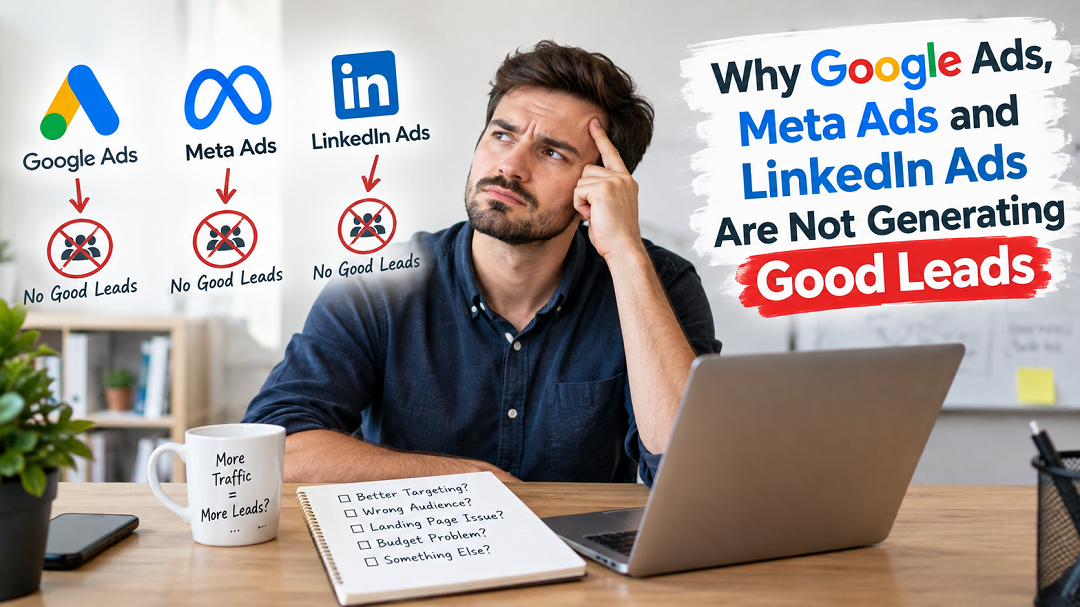
Running Google Ads, Meta Ads or LinkedIn Ads can bring thousands of impressions, clicks and even form submissions. But there is a big difference between getting leads and getting the right leads.
Many businesses face the same problem:
The ads are running. People are clicking. Leads are coming in. But very few leads become real customers.
This does not always mean that paid advertising is not working. In many cases, the real problem is somewhere inside the complete marketing funnel.
A successful paid advertising campaign is not simply:
Ad → Click → Form
It should be:
Right Audience → Relevant Ad → Strong Landing Page → Qualified Lead → Follow-Up → Customer
When one part of this process is weak, advertising costs can increase while lead quality decreases.
1. Your Campaign May Be Targeting Too Many People
One of the most common reasons for poor lead quality is overly broad targeting.
For example, a business selling high-value services may target a very general audience without considering:
- Location
- Industry
- Job role
- Business size
- Purchase intent
- Budget
- Service requirement
- Search intent
- Customer stage
The result can be many clicks from people who are interested in the topic but are not ready to purchase.
Google Ads
Google Search can provide strong purchase intent, but keyword selection matters.
A person searching:
"what is Google Ads"
has a different intent from someone searching:
"Google Ads agency for lead generation"
These users should not necessarily be treated the same way.
Understanding search intent and separating keywords into tightly relevant groups can help make the advertising message more relevant.
Meta Ads
Meta can reach a very large audience, but a large audience does not automatically mean a large number of qualified prospects.
If a campaign is optimized only for inexpensive form submissions, it may find people who are willing to submit a form without necessarily being ready to buy.
LinkedIn Ads
LinkedIn can be useful for B2B campaigns because targeting can be based on professional characteristics such as job function, seniority and company information.
However, targeting the right professional audience is only the first step. The offer and qualification process still matter.
2. Your Campaign May Be Optimizing for Leads Instead of Qualified Leads
This is one of the most important differences in paid advertising.
Imagine a campaign produces:
100 leads
But after your sales team checks them:
- 40 are irrelevant
- 25 are students or job seekers
- 15 have no budget
- 10 are outside your target market
- 5 are not currently looking for the service
- 5 are genuine potential customers
The campaign generated 100 leads.
But commercially, the business received only 5 useful opportunities.
That means the important metric is not simply:
Cost Per Lead (CPL)
You should also measure:
Cost Per Qualified Lead (CPQL)
and eventually:
Cost Per Customer
This provides a more meaningful view of campaign performance.
3. Your Landing Page May Not Match Your Advertisement
Someone clicks an advertisement because they expect a particular solution.
If the landing page does not immediately provide that solution, the visitor may leave.
For example, imagine someone searches:
"Google Ads management for small businesses"
The advertisement promises:
Google Ads Management for Small Businesses
But the visitor lands on a general digital marketing page containing:
- SEO
- Social media
- Web development
- Branding
- Content marketing
- Google Ads
- Meta Ads
- LinkedIn Ads
The visitor now has to search through the page to understand whether the service actually matches their requirement.
That creates unnecessary friction.
A better structure
For a Google Ads campaign targeting:
Google Ads Management
the landing page could focus specifically on:
Google Ads Management
Then explain:
- What you manage
- Who the service is for
- What problems you solve
- Campaign types
- Conversion tracking
- Reporting
- Lead qualification
- Frequently asked questions
- Clear CTA
The visitor should understand the offer quickly.
4. Your Advertisement May Be Attracting the Wrong Intent
Not every click represents buying intent.
Consider these searches:
"Google Ads course"
"Google Ads jobs"
"Google Ads tutorial"
"Google Ads free certification"
These may generate traffic, but they are completely different from:
"Google Ads agency"
"Google Ads management company"
"Google Ads lead generation agency"
The second group has stronger commercial intent for an advertising agency.
This is why keyword research should not focus only on search volume.
It should focus on:
Intent + Relevance + Commercial Value
5. Negative Keywords Are Extremely Important
Even a well-structured Google Ads campaign can receive unwanted searches.
For example, a business offering paid advertising management may want to avoid searches related to:
- Jobs
- Careers
- Courses
- Training
- Tutorials
- Free tools
- Templates
- Salary
- Certification
- Internship
- DIY guides
Negative keywords can help prevent ads from appearing for irrelevant searches.
Search-term analysis should therefore be an ongoing part of campaign management rather than something done only when the campaign is launched.
6. Your Offer May Be Too Generic
Another reason for poor lead quality is a generic offer.
Compare:
"Contact us for digital marketing services."
with:
"Get a free paid advertising audit and identify wasted ad spend, tracking gaps and lead-quality problems."
The second offer gives the visitor a specific reason to take action.
A good offer should answer:
Why should I contact this business now?
Depending on the business model, useful offers can include:
- Free campaign audit
- Free account review
- Landing-page review
- Conversion tracking audit
- Lead-quality analysis
- Competitor advertising analysis
- Paid media strategy consultation
7. Your Lead Form May Be Too Easy
A very short form can increase the number of submissions.
But more submissions do not necessarily mean better leads.
If your form asks only:
Name + Phone Number
you may receive many enquiries without enough information to understand the prospect.
For higher-value services, consider asking qualifying questions such as:
What service are you interested in?
What is your approximate monthly advertising budget?
Which platform are you currently using?
What is your main advertising challenge?
Which location do you want to target?
These questions can help separate genuine business enquiries from low-intent submissions.
8. Conversion Tracking May Be Incomplete
This is a major issue that many businesses overlook.
Suppose someone:
- Clicks a Google Ad
- Visits your website
- Submits a form
- Receives a call
- Becomes a qualified prospect
- Buys your service
If you track only step 3, the advertising platform does not have the complete picture.
Your measurement should ideally distinguish between:
Click
↓
Lead
↓
Contacted
↓
Qualified Lead
↓
Proposal
↓
Customer
↓
Revenue
This allows you to understand which campaigns are producing business results rather than simply generating activity.
9. Your Sales Follow-Up Can Also Affect Lead Quality
Advertising does not end when a form is submitted.
A potential customer may submit an enquiry and then receive a response several hours later.
By that time, they may have contacted another company.
A simple follow-up process can make a significant difference.
For example:
New lead received
↓
Immediate acknowledgement
↓
Sales call / WhatsApp response
↓
Understand requirement
↓
Check budget and timeline
↓
Qualify the opportunity
↓
Schedule consultation
↓
Proposal
The advertising platform can generate the opportunity, but the business still needs an effective process to convert that opportunity into revenue.
10. Don't Judge Campaign Performance Only by CPL
A low CPL can sometimes look attractive.
But consider two campaigns:
Campaign A
100 leads
₹200 CPL
5 qualified leads
Campaign B
30 leads
₹600 CPL
15 qualified leads
Campaign A appears cheaper when looking only at CPL.
But Campaign B produces more useful sales opportunities.
This is why businesses should monitor multiple metrics, including:
- Cost per click
- Conversion rate
- Cost per lead
- Qualified leads
- Cost per qualified lead
- Proposal rate
- Customer acquisition cost
- Revenue
- Return on advertising spend
The right measurement depends on the business model and sales cycle.
11. Google Ads, Meta Ads and LinkedIn Ads Need Different Strategies
There is no single campaign structure that works equally well on every advertising platform.
Google Ads
Focus heavily on:
- Search intent
- Keywords
- Negative keywords
- Ad relevance
- Landing-page relevance
- Location
- Conversion tracking
- Qualified leads
Meta Ads
Focus heavily on:
- Creative quality
- Audience testing
- Offer
- Funnel stage
- Lead qualification
- Retargeting
- Conversion signals
- Landing-page experience
Meta campaigns can require more testing of creative angles because users are generally not searching for the service at the exact moment they see the advertisement.
LinkedIn Ads
Focus heavily on:
- Industry
- Job function
- Seniority
- Company characteristics
- B2B offer
- Decision-maker targeting
- Lead qualification
- Conversion tracking
12. The Real Problem Is Usually the Funnel, Not Just the Advertisement
When a business says:
"Our ads are not giving good leads."
the first question should not be:
"Should we increase the budget?"
Instead, investigate the complete funnel.
Check the following:
1. Audience
Are we reaching the right people?
2. Intent
Are these people actually looking for the service?
3. Advertisement
Does the message clearly explain the offer?
4. Landing page
Does the page match the advertisement?
5. Form
Are we collecting enough information?
6. Tracking
Are we measuring meaningful conversions?
7. Qualification
Are we separating genuine prospects from irrelevant leads?
8. Follow-up
How quickly are new enquiries contacted?
9. Sales process
Are qualified leads moving toward proposals and customers?
10. Revenue
Which campaigns actually generate business?
A Better Paid Advertising Framework
A strong paid advertising system can be built around five stages:
Stage 1 — Target
Find the audience with the strongest relevance and intent.
Stage 2 — Attract
Create advertisements that clearly communicate the problem and solution.
Stage 3 — Convert
Send users to a relevant landing page with a clear CTA.
Stage 4 — Qualify
Collect the information needed to determine whether the enquiry is a genuine business opportunity.
Stage 5 — Optimize
Feed qualified-lead and customer information back into the measurement and advertising system where supported.
This creates a much stronger cycle:
Target → Attract → Convert → Qualify → Optimize
Instead of simply:
Spend → Click → Lead
What Businesses Should Ask Before Increasing Their Ad Budget
Before increasing advertising spend, ask:
Are we targeting the right audience?
Are our keywords showing commercial intent?
Are irrelevant searches excluded?
Does the landing page match the advertisement?
Are our forms filtering low-quality enquiries?
Are we tracking qualified leads?
Do we know which campaigns produce customers?
Is our sales team following up quickly?
If these questions cannot be answered clearly, increasing the advertising budget may simply increase the amount of data — and potentially the amount of wasted spend.
Final Thoughts
Google Ads, Meta Ads and LinkedIn Ads can all be valuable channels for generating business opportunities.
But successful paid advertising is not about getting the highest number of clicks or the lowest possible cost per lead.
The objective should be to build a system that connects:
The right audience
→ The right message
→ The right landing page
→ The right qualification process
→ The right follow-up
→ The right measurement
→ Business revenue
When businesses focus only on leads, they can easily end up optimizing for quantity.
When they start measuring qualified opportunities and customers, they can make much more informed decisions about where advertising budget is actually working.
Need Help Improving Your Paid Advertising?
At GrowNovaDigital, we help businesses plan and manage performance-focused campaigns across Google Ads, Meta Ads and LinkedIn Ads, with attention to targeting, landing pages, conversion tracking, lead qualification and ongoing campaign optimization.
If your campaigns are generating clicks but not enough genuine business enquiries, the first step may not be increasing your budget.
It may be finding out where the funnel is losing potential customers.
Explore our Paid Search & Performance Advertising Services:
https://grownovadigital.com/paid-search-performance
GrowNovaDigital — Where Digital Growth Begins