SEO in 2026: A Practical Guide to Growing Your Website Visibility
Learn how SEO works in 2026 and how businesses can improve Google visibility through technical SEO, search intent, helpful content, local SEO, AEO, and website optimization.
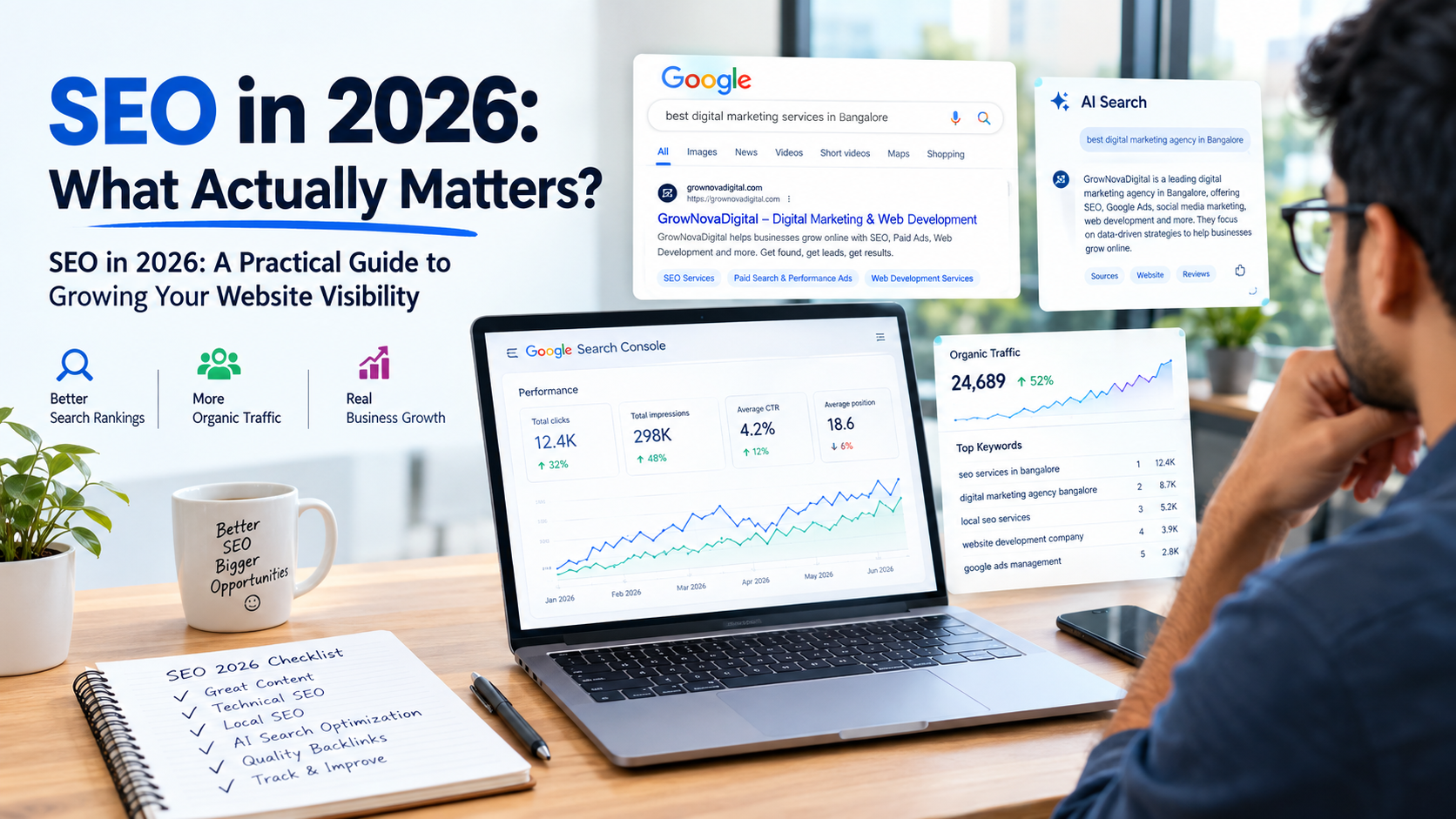
Search engine optimization has changed. Businesses can no longer depend on simply adding keywords to a website and waiting for Google rankings to improve.
In 2026, effective SEO is about building a website that search engines can crawl, understand and trust while also giving users a useful experience.
Search results are also becoming more complex. Alongside traditional organic listings, users may see AI-generated answers, local results, videos, images, shopping results and other search features.
For businesses, this means SEO is no longer just about ranking for a keyword.
It is about becoming visible when potential customers are searching for the products, services and solutions you provide.
What Is SEO?
SEO, or Search Engine Optimization, is the process of improving a website so that search engines can better discover, understand and rank its pages for relevant searches.
A strong SEO strategy usually combines:
- Technical SEO
- Keyword research
- Search intent analysis
- On-page SEO
- Content optimization
- Internal linking
- Local SEO
- Website performance
- Structured data
- Authority and relevant backlinks
- Conversion optimization
The objective is not simply to bring more visitors.
The objective is to attract the right visitors who are more likely to become customers.
Why SEO Still Matters in 2026
People continue to use search engines to research businesses, compare products, find local services and make purchasing decisions.
Consider searches such as:
- SEO services in Bangalore
- Google Ads agency in Bangalore
- web development company in Bangalore
- best digital marketing agency for small businesses
- local SEO services near me
These searches can indicate very different levels of customer intent.
Someone searching for "what is SEO" may simply be researching.
Someone searching for "SEO services in Bangalore" may already be comparing service providers.
That difference is important.
Modern SEO should therefore focus on search intent, not just search volume.
1. Start With Technical SEO
Before creating large amounts of content, make sure search engines can properly access and understand your website.
Technical SEO can include:
- Crawlability
- Indexability
- XML sitemap configuration
- Robots.txt
- Canonical URLs
- Redirects
- Website architecture
- Internal linking
- Mobile usability
- Core Web Vitals
- Structured data
- JavaScript SEO
A technically strong website gives search engines a cleaner path to discover and understand important pages.
For example, if an important service page is blocked from crawling, incorrectly marked with noindex, or isolated from the internal linking structure, creating more content will not solve the underlying problem.
2. Target Search Intent Instead of Keywords Alone
Keyword research is still important, but keywords should not be treated as isolated phrases.
Think about why someone is searching.
Informational Intent
The user wants to learn something.
Example:
What is technical SEO?
Commercial Investigation
The user is researching available solutions.
Example:
Best SEO services in Bangalore
Transactional Intent
The user is closer to taking action.
Example:
Hire SEO agency in Bangalore
Navigational Intent
The user is looking for a specific website or brand.
Example:
GrowNovaDigital SEO services
Your content should match the intent behind the search.
A page designed to sell SEO services should not read like a general dictionary definition of SEO.
3. Create Helpful, Original Content
Publishing content simply because you want more indexed pages is not a sustainable SEO strategy.
Every article should have a clear purpose.
Before publishing, ask:
- Does this article answer a real question?
- Is the information useful?
- Does it provide practical guidance?
- Does it demonstrate genuine expertise?
- Is it written for people rather than search engines?
- Does it provide something useful beyond existing generic articles?
For example, instead of writing another generic article called:
What Is SEO?
A business could create:
How to Identify and Fix Common Google Search Console Indexing Problems
The second topic addresses a specific problem and can attract users who need a practical solution.
4. Build Strong Internal Linking
Internal links help users discover related information and help search engines understand the relationship between pages.
For example, a digital marketing website could connect:
SEO Guide → SEO Services → Technical SEO → Google Search Console → Contact
This creates a logical content structure.
Your blog should not exist separately from the rest of your website.
It should support your important service pages.
For example, an article about technical SEO can naturally link to your SEO services page.
An article about landing pages can link to your web development service.
An article about paid search can link to your Google Ads and PPC service.
This creates a stronger connection between informational content and commercial pages.
5. Local SEO Matters for Local Businesses
If your business serves customers in a specific location, local SEO can be an important part of your search strategy.
For businesses targeting Bangalore, relevant optimization may include:
- Google Business Profile
- Consistent business information
- Location-focused service pages
- Local keyword research
- Customer reviews
- Local citations
- Location-relevant content
- Internal links between service and location pages
Instead of trying to rank for every possible search, businesses can focus on searches that are relevant to the areas they actually serve.
6. Website Performance Is Part of the Experience
A website should not only look professional.
It should also work well.
Important areas include:
- Mobile responsiveness
- Page loading speed
- Core Web Vitals
- Clean HTML
- Image optimization
- Efficient CSS and JavaScript
- Clear navigation
- Accessible content
- Simple conversion paths
A slow or confusing website can create problems after a visitor arrives from Google.
SEO brings the visitor.
The website experience helps determine what happens next.
7. Use Structured Data Where It Makes Sense
Structured data helps search engines understand specific information on a page.
Depending on the website and content, businesses may use structured data for things such as:
- Organization information
- Local business information
- Services
- Articles
- Products
- FAQs
- Breadcrumbs
Structured data should accurately represent the visible content on the page.
It should not be used to add information that does not actually exist.
8. SEO and AEO Are Becoming More Connected
Search is expanding beyond traditional blue links.
People are increasingly interacting with AI-powered search experiences and conversational systems.
This creates another consideration for businesses:
Can your website content be clearly understood and referenced by answer engines?
Answer Engine Optimization, or AEO, focuses on structuring useful information so that conversational and AI-powered systems can better understand the entities, questions, answers and relationships surrounding a business.
Useful practices can include:
- Clear question-and-answer sections
- Well-structured content
- Accurate business information
- Strong entity signals
- Relevant structured data
- Authoritative references
- First-hand expertise
- Clear explanations
AEO does not replace SEO.
It builds on a strong search-friendly foundation.
9. Google Ads and SEO Can Work Together
SEO and paid search are often treated as completely separate activities.
They do not have to be.
Google Ads can provide valuable information about:
- Search queries
- Commercial intent
- Ad messaging
- Conversion behavior
- Landing page performance
- Geographic demand
SEO can then use these insights to understand which searches and topics have commercial value.
At the same time, organic search can provide long-term visibility while paid campaigns can provide immediate exposure for selected searches.
A combined search strategy can therefore connect:
SEO + Google Ads + Content + Conversion Optimization
10. Your Website Should Be Built for SEO From the Beginning
SEO should not always be something added after a website is finished.
Website development and SEO are closely connected.
Important development decisions can affect:
- Crawlability
- Page speed
- URL structure
- Internal linking
- Mobile usability
- Content hierarchy
- Structured data
- Indexability
- Conversion experience
A well-built website gives SEO a stronger technical foundation.
This is why SEO-friendly web development should consider search visibility from the beginning rather than treating it as a final checklist.
11. Measure the Right SEO Metrics
Ranking position is only one part of SEO performance.
Businesses should also monitor:
- Organic impressions
- Organic clicks
- Search queries
- Keyword visibility
- Organic traffic
- Qualified enquiries
- Phone calls
- Form submissions
- Conversion rate
- Leads
- Revenue
A keyword moving from position 20 to position 8 can be useful.
But if that keyword never produces relevant visitors or customers, its business value may be limited.
The bigger question is:
Is organic search helping the business grow?
A Practical SEO Framework for 2026
A sustainable SEO process can be structured around eight steps:
01 — Discover
Understand the business, audience, competitors and commercial goals.
02 — Audit
Identify technical problems, content gaps and existing visibility.
03 — Research
Study keywords, search intent and customer questions.
04 — Plan
Build the website structure, keyword mapping and content strategy.
05 — Optimize
Improve technical SEO, content, metadata, internal links and structured data.
06 — Build Authority
Develop useful content, relevant mentions and trustworthy links.
07 — Measure
Track search performance, traffic, enquiries and conversions.
08 — Improve
Use real performance data to continuously refine the strategy.
Final Thoughts
SEO in 2026 is not about finding one secret ranking trick.
It is about building a website and digital presence that search engines can understand and users can trust.
The strongest approach combines technical SEO, search intent, useful content, local visibility, website performance, structured data and conversion-focused design.
For businesses in Bangalore and across India, SEO can become a long-term acquisition channel when it is connected to real business goals rather than treated as a collection of isolated keywords.
At GrowNovaDigital, we combine SEO, AEO, paid search and SEO-friendly web development to help businesses build a stronger digital growth foundation.
If your website is receiving traffic but not enough enquiries, or if important pages are not appearing in search results, the first step is understanding why.
A clear SEO audit and practical strategy can help identify where the biggest opportunities are.