SEO in 2026: The Complete Guide to Doing SEO the Right Way
Learn how to do SEO effectively in 2026 with practical strategies for search intent, keyword research, helpful content, technical SEO, local SEO, backlinks, AI search optimization, and performance measurement.
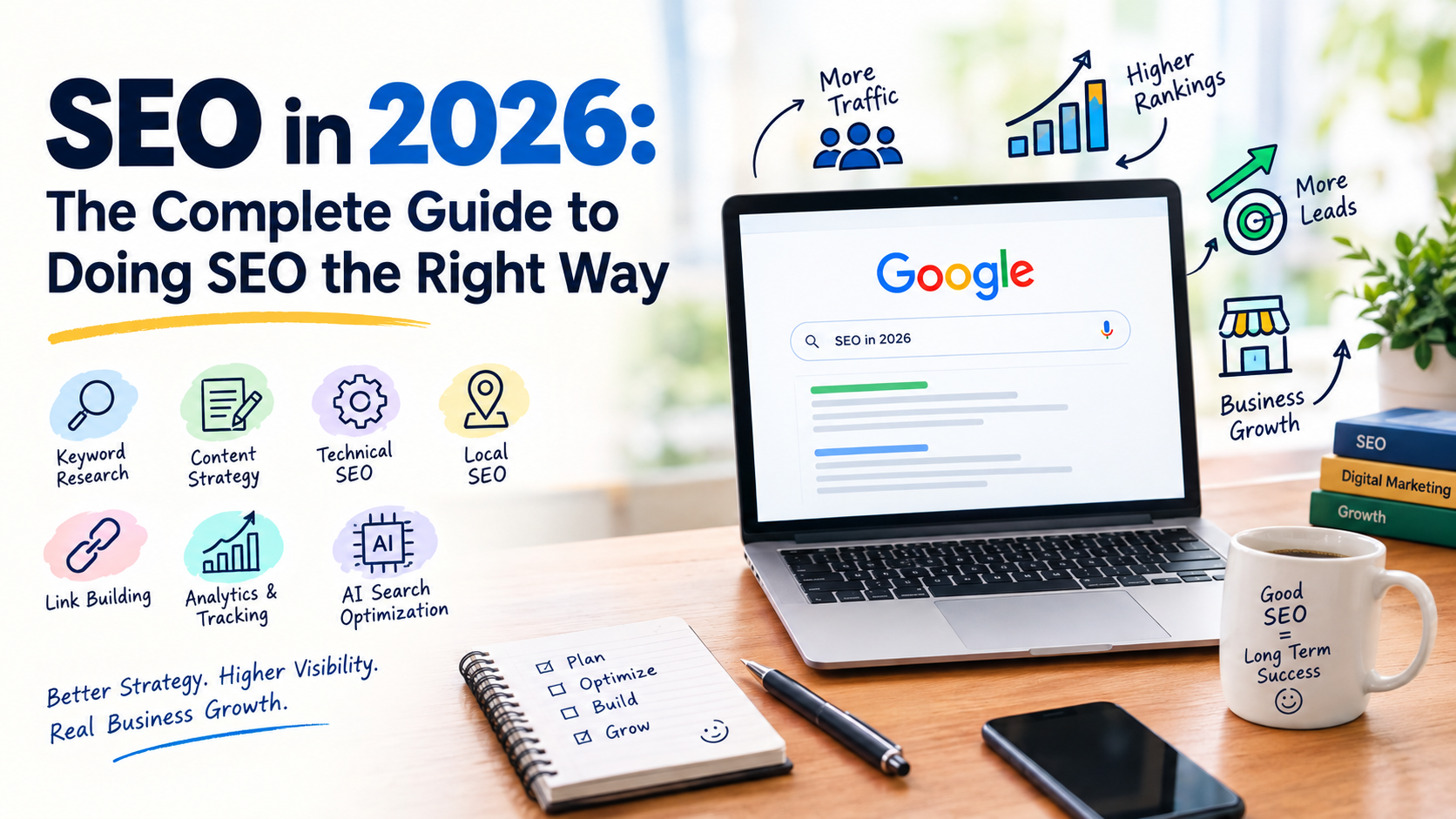
Search engine optimization has changed significantly.
Ranking on Google is no longer about simply adding keywords to a page, publishing hundreds of blog posts, or building as many backlinks as possible.
In 2026, successful SEO is about building a website that search engines can understand, users can trust, and AI-powered search systems can confidently reference.
Google continues to improve how it evaluates websites and content. Search results now include traditional organic listings alongside AI-powered experiences, local results, videos, images, shopping results, and other search features.
That means businesses need a broader SEO strategy.
The goal is no longer just:
"How do I rank #1 on Google?"
The better question is:
"How do I become one of the most useful and trustworthy sources for the people searching for my products or services?"
This guide explains how to do SEO effectively in 2026.
What Is SEO in 2026?
SEO, or Search Engine Optimization, is the process of improving a website so that search engines can discover, understand, index, and potentially rank its pages for relevant searches.
Modern SEO combines several areas:
- Technical SEO
- On-page SEO
- Keyword research
- Content SEO
- Local SEO
- Off-page SEO
- Digital PR and link building
- Image and video SEO
- Structured data
- User experience
- Conversion optimization
- AI search optimization
- Search Console monitoring
These areas work together.
A technically perfect website with poor content may not perform well.
A website with excellent content but serious indexing problems may also struggle.
And a website that receives traffic but provides a poor experience may fail to turn visitors into customers.
The best SEO strategy connects visibility, relevance, trust, and conversions.
1. Start With Search Intent
Before creating a page, understand what the searcher actually wants.
For example, someone searching for:
"SEO agency in Bangalore"
is probably looking for a service provider.
Someone searching:
"how to do keyword research"
is looking for educational information.
Someone searching:
"best SEO tools"
may be comparing different solutions.
These are different search intents.
The Four Common Types of Search Intent
Informational
The user wants to learn something.
Examples:
- What is technical SEO?
- How does Google Search work?
- How to improve website rankings?
Navigational
The user is trying to find a particular website or brand.
Examples:
- Google Search Console
- GrowNovaDigital
- Ahrefs login
Commercial Investigation
The user is researching before making a purchase.
Examples:
- Best SEO agency in Bangalore
- SEO services pricing
- SEO tools comparison
Transactional
The user is ready to take action.
Examples:
- Hire SEO agency
- Buy SEO software
- Book SEO consultation
Your content should match the intent instead of forcing every keyword onto the same page.
2. Build a Proper Keyword Strategy
Keyword research is still important in 2026, but keyword selection should go beyond search volume.
Look at:
- Search intent
- Business relevance
- Competition
- Search trends
- Long-tail queries
- Related questions
- Local searches
- Commercial value
- Existing SERP features
For example, an SEO agency shouldn't target only:
"SEO"
A more useful keyword structure could include:
Primary Keywords
- SEO services
- SEO agency
- SEO company
Service Keywords
- Technical SEO services
- Local SEO services
- Ecommerce SEO services
- On-page SEO services
- Link building services
Location Keywords
- SEO agency in Bangalore
- SEO services in Bengaluru
- Local SEO Bangalore
Informational Keywords
- How to improve Google rankings
- How does SEO work?
- SEO best practices
- How to do technical SEO
Long-Tail Keywords
- Affordable SEO services for small businesses
- Best SEO strategy for local businesses
- How to improve local Google rankings
The objective is to build topic coverage, not simply repeat one keyword.
3. Create People-First Content
One of the biggest SEO mistakes is writing content primarily for search engines.
Good content should answer the user's question clearly and provide something useful.
Ask:
- Does this page answer the searcher's question?
- Does it provide original insights?
- Is the information accurate?
- Does it demonstrate experience?
- Is the content easy to understand?
- Does it provide examples?
- Does it help the reader take action?
Avoid publishing articles simply because a keyword has search volume.
Instead, create content because your audience has a genuine problem that needs solving.
4. Make Your Content Original and Useful
Simply rewriting information that already exists on other websites is unlikely to create a strong competitive advantage.
Add something original.
For example, instead of writing:
"What is SEO?"
create:
"How We Approach SEO for Small Businesses in 2026: A Practical Step-by-Step Framework"
You can include:
- Real examples
- Screenshots
- Case studies
- Data
- Industry observations
- Before-and-after improvements
- Practical checklists
- Expert opinions
- Common mistakes
- Your own methodology
This gives users a reason to choose your page instead of another generic article.
5. Use AI Carefully for SEO Content
AI can be useful for:
- Research
- Outlining
- Brainstorming
- Content organization
- Identifying questions
- Editing
- Summarizing research
But publishing large quantities of generic AI-generated pages without adding value can create SEO problems.
A better workflow is:
Research → AI Assistance → Human Expertise → Original Insights → Fact Checking → Editing → Optimization → Publishing
AI should help you create better content, not replace expertise and originality.
6. Optimize Your Title Tag
Your title is one of the most important elements of a page.
A good title should clearly communicate:
Topic + Value + Relevance
For example:
Poor:
SEO Guide
Better:
SEO in 2026: A Practical Guide to Higher Google Rankings
For a service page:
SEO Services in Bangalore | Technical, Local & AI SEO
Avoid stuffing multiple keywords into the title.
Make the title useful for the person who sees it in search results.
7. Write Better Meta Descriptions
A meta description can help users understand what the page offers and may influence whether they click your result.
For example:
Learn how SEO works in 2026, from technical SEO and content strategy to local SEO, backlinks, structured data, and AI search optimization.
Keep it natural.
Don't turn the description into a keyword list.
Also remember that Google may generate or modify search snippets based on the page content rather than always displaying your exact meta description.
8. Use a Clear Heading Structure
Organize content logically.
For example:
H1: SEO in 2026: The Complete Guide
H2: What Is SEO?
H2: How SEO Has Changed
H2: Keyword Research
H2: Technical SEO
H2: On-Page SEO
H2: Content Strategy
H2: Local SEO
H2: Link Building
H2: AI Search Optimization
H2: SEO Measurement
H2: Common SEO Mistakes
H2: SEO Checklist
Headings should help users navigate the article.
Don't create headings simply to insert keywords.
9. Improve Internal Linking
Internal links help users and search engines discover related pages on your website.
For example, an SEO agency could connect:
SEO Services
→ Technical SEO
→ Local SEO
→ Google Ads
→ Content Marketing
→ Keyword Research
→ SEO Audit
→ SEO Blog
Instead of publishing isolated articles, build topic clusters.
For example:
Main Topic
SEO Services
Supporting content:
- Technical SEO Guide
- Local SEO Guide
- Keyword Research Guide
- On-Page SEO Guide
- Link Building Guide
- SEO Audit Guide
- Google Search Console Guide
These pages can naturally link to one another.
10. Technical SEO Still Matters
Great content cannot compensate for serious technical problems.
Your technical SEO checklist should include:
- Crawlability
- Indexability
- HTTPS
- Mobile usability
- Canonical URLs
- XML sitemap
- Robots.txt
- Redirects
- Broken links
- Duplicate content
- JavaScript rendering
- Page speed
- Core Web Vitals
- Image optimization
- Structured data
- International SEO where applicable
Regularly check your website with Google Search Console and other SEO tools.
11. Don't Ignore Core Web Vitals
Website performance affects user experience.
Pay attention to:
- LCP — Largest Contentful Paint
- INP — Interaction to Next Paint
- CLS — Cumulative Layout Shift
Improve performance by:
- Compressing images
- Using modern image formats
- Reducing unnecessary JavaScript
- Improving server response time
- Lazy-loading appropriate resources
- Removing unnecessary third-party scripts
- Using caching and a CDN where appropriate
SEO isn't just about rankings.
A faster website can also create a better experience for visitors.
12. Optimize Images for Search
Images are an important part of modern search.
Use:
- Descriptive file names
- Relevant alt text
- Appropriate image formats
- Responsive images
- Proper dimensions
- Compressed files
- Relevant surrounding text
For example, instead of:
IMG12345.jpg
use:
seo-agency-bangalore-technical-seo.jpg
Alt text should describe the image naturally.
Don't use alt text as a place to stuff keywords.
13. Use Structured Data Correctly
Structured data helps search engines understand the content of a page.
Depending on the website, relevant structured data may include:
- Organization
- LocalBusiness
- Article
- BreadcrumbList
- Product
- Service
- Event
- Person
- Review-related markup where eligible
But structured data is not a guaranteed ranking shortcut.
Implement markup that accurately represents visible and relevant information on the page.
Also validate your implementation and monitor it in Search Console.
14. Local SEO Is Essential for Local Businesses
If you operate a local business, traditional organic SEO isn't enough.
You should optimize your local presence.
Important areas include:
- Google Business Profile
- Business name consistency
- Address
- Phone number
- Website
- Business categories
- Services
- Reviews
- Photos
- Local landing pages
- Local citations
- Relevant backlinks
- Local content
Create useful location-specific pages where there is genuine local relevance.
For example:
SEO Agency in Bangalore
is more useful for a Bangalore-focused agency than simply targeting:
SEO Agency
15. Build High-Quality Backlinks
Backlinks remain an important part of SEO, but quality matters more than raw quantity.
A good backlink can come from:
- Relevant industry websites
- News publications
- Professional organizations
- Local publications
- Partner websites
- Industry directories
- Original research
- Digital PR
- Useful resources
- Genuine guest contributions
Avoid building hundreds of low-quality links just to increase a third-party metric such as Domain Authority.
Link building should focus on genuine relevance and value.
16. Build Topical Authority
One article rarely establishes strong expertise in a competitive subject.
Suppose your website focuses on SEO.
Instead of publishing random articles, create a structured content ecosystem.
SEO
→ Technical SEO
→ On-Page SEO
→ Off-Page SEO
→ Local SEO
→ Ecommerce SEO
→ Enterprise SEO
→ AI Search
→ SEO Analytics
→ Keyword Research
→ SEO Tools
Each topic can have:
- Pillar pages
- Supporting articles
- Case studies
- FAQs
- Service pages
- Guides
This creates a stronger content architecture.
17. Optimize for AI Search
Search is increasingly incorporating generative AI experiences.
Traditional SEO fundamentals remain important for modern AI-powered search experiences.
To improve your chances of being useful to AI-powered search systems:
Answer Questions Clearly
Put the direct answer near the beginning of relevant sections.
Provide Unique Information
Add data, examples, experience, and original analysis.
Build Topical Depth
Cover the subject comprehensively rather than creating thin pages.
Demonstrate Expertise
Clearly communicate who created the content and why they are qualified.
Keep Information Accurate
Update outdated statistics, services, pricing, and technical information.
Structure Information Clearly
Use:
- Descriptive headings
- Lists
- Tables
- Definitions
- Step-by-step instructions
- FAQs where genuinely useful
Don't treat "AEO" or "GEO" as a replacement for SEO.
Strong fundamentals remain the foundation.
18. Create Content in Multiple Formats
Modern search isn't limited to traditional organic listings.
Depending on your business, create:
- Blog articles
- Videos
- Images
- Infographics
- Case studies
- Guides
- Original research
- FAQs
- Product pages
- Service pages
- Local content
A strong content strategy can help your brand appear across different search experiences.
19. Use Google Search Console as Your SEO Dashboard
Google Search Console should be part of your regular SEO workflow.
Monitor:
- Clicks
- Impressions
- CTR
- Average position
- Indexed pages
- Page indexing issues
- Sitemap status
- Search queries
- Search appearance
- Core Web Vitals
- Manual actions
- Security issues
Don't just look at rankings.
Look for:
High impressions + low CTR
This may indicate that your title or search appearance needs improvement.
High impressions + position 8–20
These pages may be candidates for content improvement and internal linking.
High clicks + poor conversions
The SEO may be working, but the landing page or offer may need improvement.
20. SEO Should Lead to Business Results
Traffic is not the final objective.
For a business website, track:
Organic Visibility → Clicks → Visitors → Engagement → Leads → Sales
For example:
10,000 organic visitors with no leads may be less valuable than 1,000 highly relevant visitors that generate 50 qualified enquiries.
Track conversions through tools such as:
- Google Analytics
- Google Search Console
- Google Tag Manager
- CRM
- Call tracking
- Form tracking
- WhatsApp click tracking
SEO should ultimately contribute to business growth.
21. Common SEO Mistakes to Avoid in 2026
Keyword Stuffing
Repeating a keyword unnaturally doesn't create better content.
Publishing Hundreds of AI Pages
Quantity without value can create low-quality content and spam risks.
Buying Poor-Quality Backlinks
A large number of irrelevant links isn't a sustainable SEO strategy.
Copying Competitors
Your website needs its own expertise, examples, and value.
Ignoring Technical SEO
Excellent content cannot perform properly if important pages aren't crawlable or indexable.
Creating Duplicate Location Pages
Don't create dozens of nearly identical city pages simply by changing the location name.
Ignoring Existing Content
Sometimes improving an existing page is more valuable than publishing another article.
Chasing Every Algorithm Update
Focus on building a technically healthy website and genuinely useful content rather than trying to reverse-engineer every ranking change.
22. A Practical SEO Process for 2026
If you want a simple framework, follow this process.
Step 1: Audit the Website
Check:
- Technical SEO
- Indexing
- Content
- Backlinks
- Internal links
- Page speed
- Local SEO
- Analytics
Step 2: Research the Market
Identify:
- Competitors
- Search intent
- Keywords
- Content gaps
- Commercial opportunities
Step 3: Build Your Keyword Map
Assign primary and secondary keywords to the correct pages.
Step 4: Fix Technical Problems
Resolve:
- Indexing issues
- Broken links
- Canonical problems
- Duplicate pages
- Sitemap problems
- Performance issues
Step 5: Improve Existing Pages
Update important pages before creating unnecessary new ones.
Step 6: Create High-Value Content
Publish content that solves real customer problems.
Step 7: Strengthen Internal Linking
Connect related pages logically.
Step 8: Build Relevant Authority
Earn backlinks, mentions, citations, and digital PR from relevant sources.
Step 9: Optimize Local Visibility
Improve Google Business Profile, reviews, local pages, and citations where relevant.
Step 10: Measure and Improve
Use Search Console, Analytics, and business data to identify opportunities.
Then repeat the process.
23. The 2026 SEO Checklist
Before publishing a page, check:
Keyword & Intent
☐ Search intent is understood
☐ Primary keyword is relevant
☐ Related topics are covered
☐ Page matches the user's goal
Content
☐ Original information
☐ Useful examples
☐ Accurate information
☐ Clear structure
☐ Human-readable writing
☐ No unnecessary keyword stuffing
On-Page SEO
☐ SEO-friendly title
☐ Useful meta description
☐ One clear H1
☐ Logical H2/H3 structure
☐ Optimized images
☐ Descriptive URLs
☐ Internal links
Technical SEO
☐ Page is indexable
☐ Canonical is correct
☐ Sitemap is updated
☐ Robots.txt isn't blocking important content
☐ Mobile-friendly
☐ HTTPS enabled
☐ Good page performance
Authority
☐ Relevant backlinks
☐ Brand mentions
☐ Author/expertise signals where appropriate
☐ Original research or experience
Measurement
☐ Search Console configured
☐ Analytics configured
☐ Conversion tracking configured
☐ Rankings monitored
☐ Organic traffic monitored
☐ Leads/sales tracked
Final Thoughts: What Does Good SEO Look Like in 2026?
The best SEO strategy isn't about finding one secret ranking trick.
It's about consistently improving the entire search experience.
A successful SEO strategy combines:
Technical SEO + Search Intent + Helpful Content + On-Page SEO + Internal Linking + Local SEO + Authority + Structured Data + User Experience + AI Search Readiness + Measurement
Most importantly, don't build a website just to satisfy an algorithm.
Build it to become the best answer, resource, or solution for the people you want to reach.
SEO is therefore not disappearing.
SEO is becoming broader, more technical, more competitive, and more focused on genuine value.
Businesses that invest in useful content, strong technical foundations, real expertise, and a consistent digital presence can build a stronger foundation for organic visibility in 2026 and beyond.
If your website needs a structured SEO strategy—from technical audits and on-page optimization to local SEO, content strategy, link building, and AI-search optimization—GrowNovaDigital can help build and execute a strategy around your actual business goals.
Learn more about SEO services: