Which Paid Advertising Strategy Is Best for Your Business in 2026?
Compare Google Ads, Meta Ads, LinkedIn Ads, WhatsApp and email marketing to understand which paid advertising strategy is best for your business in 2026.
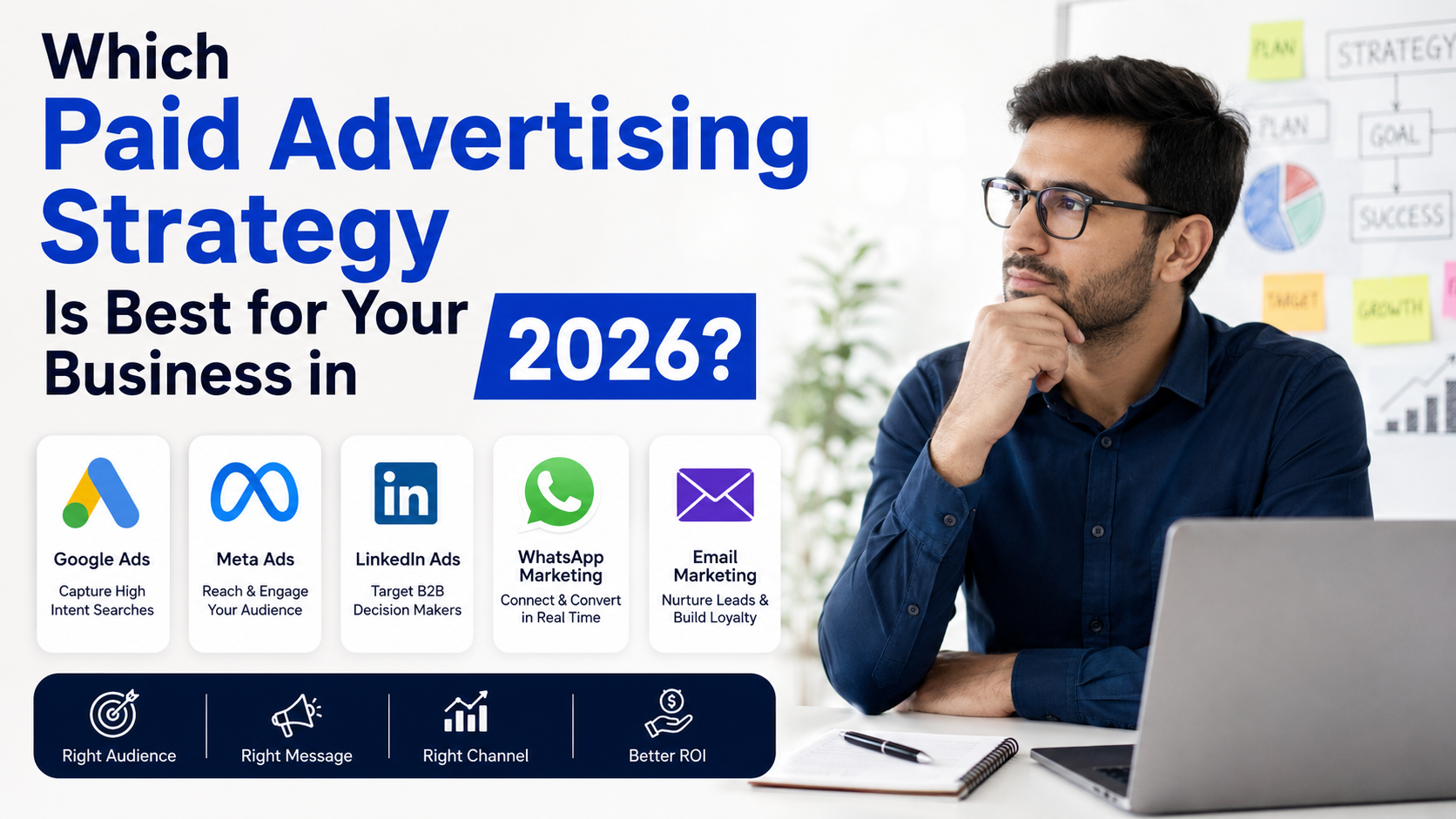
If you're planning to spend money on digital advertising, one of the first questions you will probably ask is:
“Which advertising platform is best for my business?”
Should you invest in Google Ads, Meta Ads, LinkedIn Ads, WhatsApp marketing, or email marketing?
There is no single platform that is best for every business.
A local restaurant, e-commerce brand, B2B software company, real estate business, and professional services company can all have completely different advertising requirements.
The right paid advertising strategy depends on who your customers are, what they are looking for, how they make purchasing decisions, and how much a new customer is worth to your business.
Google Ads can be powerful when customers are already searching for a solution. Meta Ads can help create demand and reach people based on interests and behaviour. LinkedIn Ads can be useful for B2B companies targeting professionals and decision-makers. WhatsApp and email can become valuable after you have captured a lead or customer.
So instead of asking:
“Which platform is the best?”
A better question is:
“Which platform is best for my business objective?”
The 5 Major Paid Advertising and Performance Marketing Channels
For many businesses, the major channels worth evaluating are:
- Google Ads / PPC
- Meta Ads – Facebook & Instagram
- LinkedIn Ads
- WhatsApp Marketing
- Email Marketing
These channels don't necessarily compete with each other.
In many cases, the strongest strategy is to use them at different stages of the customer journey.
For example:
Google Search → Website → Lead Form → WhatsApp Follow-up → Sales Call → Email Nurturing → Customer
That's very different from simply running an advertisement and hoping somebody buys.
Google Ads – Best When Customers Are Already Searching
Google Ads can be a strong option when potential customers already know what they need and are actively searching for it.
For example:
- “SEO agency in Bangalore”
- “best wedding photographer Bangalore”
- “AC repair near me”
- “industrial RO plant manufacturer”
- “CRM software for small business”
- “digital marketing agency Bangalore”
These searches indicate a level of existing demand.
Someone searching for “what is SEO?” may simply be researching.
Someone searching for “SEO agency Bangalore pricing” is much closer to making a commercial decision.
That difference is extremely important in PPC advertising.
Why Google Ads Can Work Well
Google Search allows businesses to appear when people are actively looking for relevant products or services.
Campaigns can be built around:
- Commercial keywords
- Search intent
- Location
- Devices
- Audiences
- Search terms
- Conversion data
- Budget
- Bidding strategies
But simply selecting keywords isn't enough.
A profitable Google Ads campaign needs to answer three important questions:
Are we reaching the right people?
Are we paying for the right searches?
Are those visitors becoming valuable leads or customers?
That's why conversion tracking, negative keyword management, landing-page relevance, ad quality, and continuous optimization matter.
Google Ads should be treated as a performance channel rather than simply a way to generate website traffic.
Google Ads Is Especially Suitable For
- Local service businesses
- Professional services
- B2B services
- High-value services
- E-commerce
- Appointment-based businesses
- Home services
- Education
- Software and technology
- Businesses with strong commercial search demand
Example
Suppose you sell industrial water treatment equipment.
Someone searching:
“industrial ETP plant manufacturer in Bangalore”
may already have a specific requirement.
That type of search can be very different from showing a general advertisement to someone who is simply browsing social media.
This is where search intent becomes an important advantage of Google Ads.
Meta Ads – Best for Creating Demand and Reaching Audiences
Meta Ads covers advertising across platforms such as Facebook and Instagram.
The biggest difference from Google Search is the customer's mindset.
On Google, the user may already be searching for a solution.
On Instagram or Facebook, the user may not be searching for your product at all.
You have to capture their attention and create interest.
That makes Meta Ads useful for:
- Brand awareness
- Product discovery
- E-commerce
- Local businesses
- Restaurants
- Fashion
- Beauty
- Fitness
- Events
- Consumer services
- Lead generation
- Remarketing
For example, someone may not search Google for:
“new skincare brand for sensitive skin.”
But a well-designed Instagram advertisement can introduce the product, demonstrate the problem it solves, and give the person a reason to visit the website.
Meta Ads Is Strong When Creative Matters
Your advertisement has to compete with everything else in a user's social media feed.
That means your creative needs to communicate the message quickly.
A useful structure can be:
Creative → Hook → Problem → Solution → Proof → Offer → CTA
A visually attractive advertisement with no clear offer may generate attention without generating sales.
Likewise, a strong offer with poor creative may not receive enough attention.
Meta Ads Can Be Particularly Effective For
- Visual products
- Consumer brands
- E-commerce
- Offers and promotions
- Lead generation
- Remarketing
- Product launches
- Local businesses
Example
A restaurant launching a weekend family combo could use Instagram Reels and Facebook advertising to show:
Food → Family → Offer → Location → Call/WhatsApp
The customer may not have been looking for the restaurant a few minutes earlier.
The advertisement creates awareness and encourages discovery.
LinkedIn Ads – Useful for B2B and Professional Audiences
LinkedIn is different from both Google and Meta because its advertising environment is strongly connected to professional audiences.
Businesses can build campaigns around characteristics such as:
- Job title
- Job seniority
- Company
- Company size
- Industry
- Skills
- Education
- Professional interests
LinkedIn advertising can therefore be useful for companies selling products or services to other businesses.
LinkedIn Ads Can Be Useful For
- SaaS companies
- IT services
- Consulting
- HR services
- Recruitment
- Enterprise software
- Industrial companies
- Corporate training
- B2B agencies
- Professional services
- High-value B2B products
Example
Imagine you sell enterprise HR software.
Instead of trying to reach a broad consumer audience, you may want to reach:
HR Managers + HR Directors + Companies with 200–1,000 employees
Professional audience targeting can help make the campaign more relevant to the people involved in the buying process.
However, LinkedIn Ads may not be necessary for every business.
You don't need LinkedIn advertising simply because LinkedIn is a popular platform.
The important question is whether your potential buyers are active there and whether the economics make sense for your business.
WhatsApp Marketing – Useful for Conversations and Lead Follow-Up
WhatsApp is not always the channel where you should create demand.
For many businesses, its bigger value comes after someone has shown interest.
For example:
Advertisement → Lead → WhatsApp Conversation → Qualification → Sales
This can work particularly well for businesses where customers want to ask questions before making a purchase.
Examples include:
- Real estate
- Education
- Clinics
- Restaurants
- Travel
- Local services
- Events
- Personal services
- High-consideration products
A website form might capture:
Name + Phone Number + Requirement
WhatsApp can then continue the conversation.
Businesses can use relevant conversations to share:
- Pricing
- Brochures
- Product information
- Photos
- Videos
- Locations
- Appointment details
- Offers
However, WhatsApp marketing should not become a channel for sending unwanted promotional messages.
It works best when customers have a legitimate reason to communicate with the business and the conversation remains relevant.
Email Marketing – Best for Nurturing and Repeat Business
Email marketing is sometimes overlooked because it doesn't always create an immediate impact.
However, for businesses with an existing customer or prospect database, email can be extremely useful.
Consider a potential customer who isn't ready to buy today.
Instead of losing that lead completely, you can continue providing useful information through email.
For example:
Lead → Welcome Email → Educational Content → Case Study → Offer → Sales
Email can also support:
- Existing customers
- Repeat purchases
- Product launches
- Promotions
- Newsletters
- Abandoned carts
- Lead nurturing
- Customer retention
This becomes particularly valuable when the sales cycle is longer.
For example, a B2B company may not convert a prospect after seeing one advertisement.
The customer may need:
Research → Comparison → Internal Discussion → Demo → Proposal → Approval
Email can help maintain the relationship throughout that process.
Google Ads vs Meta Ads vs LinkedIn Ads vs WhatsApp vs Email
| Channel | Best For | Customer Intent | Suitable Business Types |
|---|---|---|---|
| Google Ads | Capturing existing demand | High | Services, B2B, local, e-commerce |
| Meta Ads | Creating demand and discovery | Low–Medium | Consumer brands, e-commerce, local |
| LinkedIn Ads | B2B targeting | Medium–High | SaaS, B2B, professional services |
| Conversations and follow-up | Medium–High | Local, services, high-consideration | |
| Nurturing and retention | Existing audience | B2B, e-commerce, services |
The important point is that the best advertising channel depends on the stage of the buying journey.
Which Platform Is Best for Lead Generation?
If your objective is generating leads, don't automatically choose the platform with the cheapest cost per lead.
A ₹100 lead isn't necessarily better than a ₹500 lead.
The real question is:
How many of those leads become customers?
Imagine two campaigns.
Campaign A
100 leads × ₹100 = ₹10,000
Only 2 become customers.
Campaign B
20 leads × ₹500 = ₹10,000
5 become customers.
Campaign B has a higher cost per lead but may produce more customers from the same advertising spend.
That's why businesses should look beyond:
CPC → CTR → CPL
and eventually measure:
Lead → Qualified Lead → Opportunity → Customer → Revenue
This is why conversion tracking should be connected to actual business outcomes rather than stopping at clicks or form submissions.
Which Platform Is Best for E-Commerce?
For e-commerce, there isn't necessarily one channel that does everything.
A combination of platforms can support different parts of the customer journey.
Google Ads
Capture people actively searching for products.
Meta Ads
Create product discovery and retarget interested users.
Bring previous visitors and customers back.
Answer questions and support high-consideration purchases where appropriate.
For example:
Meta Ad → Product Page → Visitor → Remarketing → Purchase → Email → Repeat Purchase
The objective isn't to make every channel perform the same job.
It's to give each channel a specific role.
Which Platform Is Best for Local Businesses?
Local businesses can consider a combination of Google Ads, Meta Ads and WhatsApp depending on their audience and goals.
Consider a local dental clinic.
Google Ads
Target searches such as:
“dentist near me”
Meta Ads
Show educational videos, offers and relevant content to local audiences.
Allow interested prospects to ask questions and book an appointment.
The three channels perform different roles:
Google captures existing intent.
Meta creates awareness and discovery.
WhatsApp facilitates conversation and follow-up.
Which Platform Is Best for B2B Businesses?
For many B2B businesses, the strongest strategy may not be LinkedIn alone.
A combination of Google Ads + LinkedIn + content + email + sales follow-up can support different stages of the buying journey.
For example:
Google Search
Capture someone actively searching for a solution.
↓
Landing Page
Explain the product, service and value proposition.
↓
Lead Form
Capture the prospect.
↓
Send useful information, case studies and relevant resources.
↓
Sales Team
Qualify the opportunity.
↓
Build professional visibility and reach relevant decision-makers.
B2B buying journeys can take weeks or months, so expecting one advertisement to immediately generate a sale may not reflect the actual buying process.
What About a Small Advertising Budget?
This is where many businesses make a common mistake.
They try to advertise on:
Google + Meta + LinkedIn + YouTube + WhatsApp + everything else
with a small budget.
The result can be insufficient data across every platform.
Instead, start with the channel most closely connected to your business objective.
If Your Budget Is Limited
High-intent service business
Start by testing Google Search.
Consumer product
Consider testing Meta Ads.
B2B product or service
Test Google Search and consider LinkedIn when the audience and economics justify it.
Existing customer database
Use email and WhatsApp to support retention and follow-up.
Once you have enough data, you can evaluate additional channels.
Don't Choose an Advertising Platform Before Understanding Your Customer
Before spending money on advertising, answer these questions.
1. Who Is the Customer?
Is the customer a:
- Consumer?
- Business?
- Professional?
- Decision-maker?
- Local customer?
Understanding this helps narrow your channel selection.
2. What Does the Customer Search For?
If customers actively search for your product or service, Google Ads may be worth testing.
3. Does the Customer Need to See the Product First?
If visual discovery plays an important role, Meta Ads may be useful.
4. Is Your Product B2B?
If your target customers are businesses and professionals, LinkedIn may be worth evaluating.
5. Does the Customer Need a Conversation Before Buying?
If customers need answers before purchasing, WhatsApp can become an important conversion and follow-up channel.
6. Is the Sales Cycle Long?
If customers take weeks or months to make a decision, email nurturing and remarketing may become more important.
7. What Is One Customer Worth?
A business selling a ₹500 product and a business selling a ₹5 lakh service cannot necessarily use the same customer acquisition strategy.
Your customer value should influence your advertising budget, targeting, tracking and optimization approach.
The Biggest Advertising Mistake: Optimizing for Clicks Instead of Business Results
Getting clicks feels good.
Getting impressions feels good.
Getting leads feels even better.
But none of these automatically mean your advertising is profitable.
A performance marketing strategy should ultimately answer:
How much did we spend?
How many qualified leads did we generate?
How many became customers?
How much revenue did those customers generate?
What did it cost to acquire each customer?
That's why tracking matters.
For Google Ads, this can include tracking actions such as:
- Form submissions
- Phone calls
- WhatsApp enquiries
- Purchases
- Quote requests
- Bookings
The goal is to understand what happens after the click.
The Best Strategy Is Often a Combination of Channels
Instead of looking at advertising platforms as competitors, think of them as different parts of one system.
Example Performance Marketing Funnel
Google Ads
↓
Capture high-intent traffic
↓
Landing Page
↓
Convert visitor into lead
↓
WhatsApp / Phone
↓
Qualify the lead
↓
↓
Nurture the prospect
↓
Sales
↓
Convert customer
↓
Meta Remarketing
↓
Stay visible to interested prospects
↓
Email / WhatsApp
↓
Repeat purchase or upsell
This is much closer to how real customers behave.
People don't necessarily see one advertisement, click it and immediately purchase.
They may interact with a business several times before making a decision.
So, Which Paid Advertising Platform Is Best?
The answer depends on your business objective, audience, product or service, customer journey and budget.
Choose Google Ads When
People are already searching for your product or service.
Choose Meta Ads When
You need to create demand, reach new audiences or visually showcase your product.
Choose LinkedIn Ads When
Your ideal customers are professionals, companies or decision-makers.
Choose WhatsApp Marketing When
Conversation, follow-up and quick communication are important to conversion.
Choose Email Marketing When
You already have leads or customers and want to nurture, retain or reactivate them.
Use Multiple Channels When
Your customer journey is longer and requires several touchpoints.
There is no universal “best advertising platform.”
The right choice is the channel or combination of channels that fits your business objective, target audience and stage of the buying journey.
Final Takeaway
Paid advertising shouldn't be treated as simply:
“Put ₹10,000 into ads and see what happens.”
A stronger approach is:
Business Goal → Customer Research → Channel Selection → Offer → Campaign → Landing Page → Tracking → Optimization → Scale
Google Ads can capture existing demand.
Meta Ads can create discovery.
LinkedIn Ads can reach professional audiences.
WhatsApp can turn interest into conversations.
Email can nurture and retain customers.
When these channels are selected based on the actual customer journey—not simply because they are popular—the advertising budget can be managed around measurable business outcomes.
The goal isn't to be present on every advertising platform.
The goal is to identify where your potential customers are, understand how they make decisions, and build a paid advertising strategy that supports the entire journey from first interaction to customer.
Need Help With Your Paid Advertising Strategy?
Choosing the right platform is only the beginning.
A campaign still needs the right keywords, audience targeting, ad copy, budget allocation, conversion tracking, landing pages, negative keywords, bidding strategy and continuous optimization.
At GrowNovaDigital, we help businesses build performance-focused paid search campaigns around qualified leads, sales and measurable conversions.
Our Google Ads and PPC management approach can include:
- Google Search Ads
- PPC campaign management
- Keyword and search-intent research
- Negative keyword management
- Performance Max management
- Conversion tracking
- Google Analytics and Google Tag Manager setup
- Landing-page optimization
- Remarketing
- Smart Bidding
- Budget optimization
- Campaign audits
- Continuous performance optimization
We focus on more than clicks. The goal is to connect advertising spend with leads, qualified enquiries, customers and revenue.
Want to know whether Google Ads is suitable for your business?
Explore our Google Ads & PPC Management Services:
https://grownovadigital.com/paid-search-performance
Get your paid advertising strategy assessed before increasing your ad budget.