AI SEO Tools Are Everywhere — So Why Do Businesses Still Need an SEO Specialist?
AI SEO tools can automate keyword research, content creation, technical audits and backlink analysis, but businesses still need SEO specialists for strategy, human judgment, search intent and long-term organic growth.
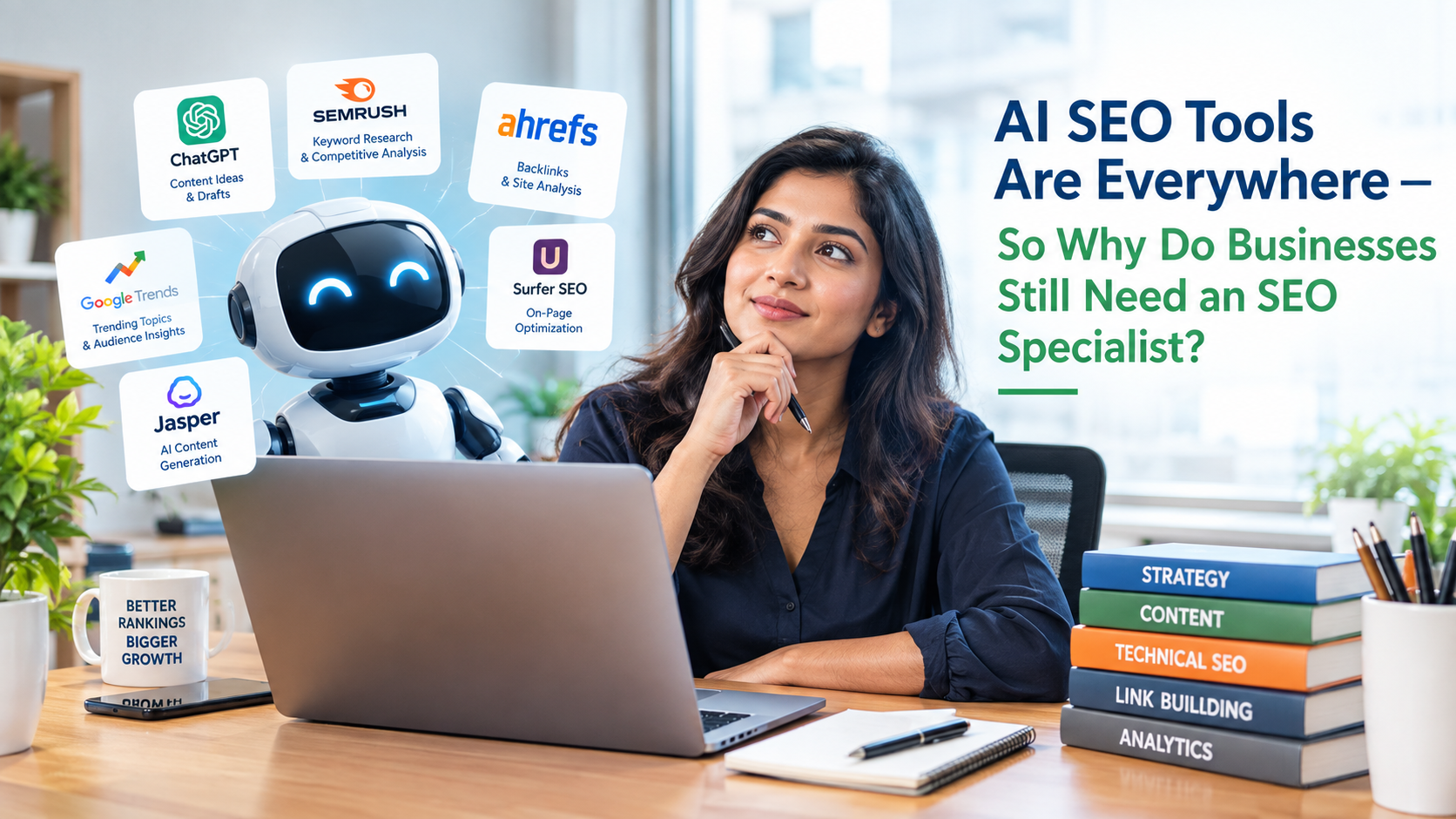
AI has changed digital marketing faster than most businesses expected.
Today, you can find AI tools for almost everything: keyword research, content writing, SEO audits, meta descriptions, technical checks, competitor analysis, backlink generation, website optimisation, social media content and even automated SEO campaigns.
Some tools promise to build hundreds of backlinks automatically.
Others promise to generate dozens or even hundreds of SEO articles in a short time.
At first, this sounds like the perfect solution.
If software can do SEO automatically, why should a business spend money hiring an SEO specialist?
The answer is simple:
SEO is not just about producing content, generating backlinks or fixing technical errors. SEO is about making the right decisions for a real business, its customers, its market and its long-term search visibility.
AI can help with SEO.
Automation can save time.
But neither automatically understands your business strategy.
The Rise of AI-Powered SEO
The SEO industry has entered a new stage.
A few years ago, many SEO tasks required hours of manual research. Today, AI can help analyse keywords, generate content ideas, identify technical issues, create outlines, summarise competitors and assist with many repetitive tasks.
This is genuinely useful.
For example, an AI tool can help an SEO professional:
- Discover potential keyword ideas
- Group keywords by search intent
- Create content outlines
- Analyse large amounts of data
- Find possible technical SEO issues
- Generate title and meta description ideas
- Identify content gaps
- Assist with internal-linking ideas
- Speed up repetitive research
- Help produce initial content drafts
The problem begins when businesses assume that automation itself is an SEO strategy.
It isn't.
“I Can Generate 500 Backlinks. Why Do I Need SEO?”
This is one of the most common misunderstandings.
There are automated backlink tools that advertise the ability to create large numbers of links quickly.
A business owner might think:
“If my competitor has 1,000 backlinks and this tool can create 1,000 backlinks for me, my website should rank higher.”
Unfortunately, SEO doesn't work that simply.
A backlink is not valuable merely because it exists.
The important questions are:
Where did the link come from?
Is the website relevant to your industry?
Is the page trustworthy and useful?
Was the link naturally earned?
Is the surrounding content relevant?
Does the link actually help users?
Could the link be considered manipulative?
Search engine spam policies identify the use of automated programs or services to create links to a website as an example of link spam.
That means a software-generated backlink count can look impressive inside a dashboard while providing little meaningful SEO value — and potentially creating problems if the links are part of manipulative practices.
More Backlinks Does Not Always Mean Better SEO
Imagine two websites.
Website A
It has 5,000 automatically generated links from unrelated websites, directories, comments and low-quality pages.
Website B
It has 80 relevant links from websites, publications, organisations and resources connected to its industry.
Looking only at the numbers, Website A appears to have more links.
But backlink quantity alone does not tell the whole story.
SEO professionals need to evaluate the quality, relevance, context and purpose of links.
This is one reason automated backlink reports can be misleading for business owners.
A software dashboard may say:
“You gained 500 backlinks!”
An SEO specialist may ask:
“Are those 500 links actually helping your website?”
Those are two completely different questions.
The Biggest Problem With Automated Backlink Generators
The biggest problem isn't simply that automated links may be low quality.
The bigger problem is that automation can remove human judgment from an area where judgment matters.
A backlink tool doesn't necessarily understand:
- Your target customers
- Your geographical market
- Your products and services
- Your competitors
- Your brand reputation
- Your industry's authority websites
- Which publications are genuinely relevant
- Which websites are suspicious
- Which anchor text is appropriate
- Which pages deserve links
- Whether a link makes sense to a real visitor
A tool can follow rules.
An SEO specialist can evaluate context.
That difference matters.
AI-Generated Content Has a Similar Problem
AI can create an article in seconds.
But producing an article and producing a useful article are not the same thing.
Imagine a company selling industrial water-treatment systems.
An AI tool can generate an article about wastewater treatment.
But does the article understand:
- The company's actual technology?
- The industries it serves?
- The installation process?
- Regulatory requirements?
- Customer concerns?
- Project size?
- Local market conditions?
- Real customer questions?
- The company's competitive advantages?
Without proper human input, AI content can become generic.
Google's guidance does not say that using AI automatically makes content unacceptable. The concern is content created at scale primarily to manipulate search rankings rather than provide value to users.
So the real question isn't:
“Was AI used?”
The better question is:
“Was the content created to genuinely help the user?”
AI Can Create Content Faster — But Faster Isn't Always Better
Suppose a website publishes:
100 AI articles in one month.
That sounds impressive.
But if those articles:
- Repeat the same information
- Target almost identical keywords
- Have little original insight
- Don't answer real customer questions
- Contain inaccurate information
- Exist mainly to capture search traffic
- Have weak internal linking
- Don't support the company's services
then the website may simply have 100 more pages, not 100 better SEO assets.
SEO is not a race to publish the largest number of pages.
It is about building useful search visibility.
Keyword Stuffing Can Also Be Automated
Another problem is excessive keyword optimisation.
A tool might identify a keyword such as:
SEO Services in Bangalore
A poorly configured automation system may repeatedly insert that phrase into:
- Headings
- Paragraphs
- Meta descriptions
- Image alt text
- URLs
- Anchor text
- Multiple pages
The result may technically contain the keyword, but the writing can become unnatural.
Search engine spam documentation describes keyword stuffing as filling pages with keywords or numbers in an attempt to manipulate search rankings.
Good SEO doesn't mean repeating a keyword as many times as possible.
It means understanding search intent and creating a page that satisfies it.
Search Intent Is Where Human Strategy Matters
Consider these searches:
“best laptop for graphic design”
“laptop repair near me”
“buy laptop online”
“laptop screen replacement cost”
They all relate to laptops, but they represent different needs.
An automated tool may identify the keywords.
An SEO specialist needs to understand the intent behind them.
For a business, this affects:
- Which page should target the query
- What content should appear on that page
- What offer should be presented
- What call-to-action should be used
- Whether the visitor is ready to buy
- Whether the keyword is worth targeting
- How the page should connect with the rest of the website
This is where SEO becomes a business strategy rather than a software task.
Another Problem: AI Can Be Confidently Wrong
AI tools can produce impressive-looking answers.
But impressive-looking information isn't necessarily accurate.
An AI-generated SEO article might contain:
- Incorrect statistics
- Outdated information
- Incorrect technical recommendations
- Unsupported claims
- Misunderstood search intent
- Incorrect descriptions of a company's services
If that content gets published without review, the company — not the AI tool — owns the problem.
For businesses, reputation matters.
A customer who discovers incorrect information on a company website may question the company's credibility.
That's why AI output should generally be treated as assistance that needs review, not as unquestionable expertise.
Technical SEO Cannot Be Solved by One “Audit Score”
Many AI SEO platforms provide a website score such as:
SEO Score: 92/100
That number can be useful as a diagnostic indicator.
But it doesn't tell the complete story.
A website can have excellent technical scores and still struggle to generate business.
Why?
Because technical SEO is only one part of the picture.
A complete SEO strategy may need to consider:
- Technical SEO
- Keyword strategy
- Search intent
- Content quality
- Internal linking
- Local SEO
- Website structure
- Conversion optimisation
- Competitor analysis
- Backlink profile
- Brand visibility
- User experience
- Business goals
- Search demand
A score can identify problems.
A specialist has to decide which problems actually matter most.
The Difference Between an SEO Tool and an SEO Specialist
Think about it like using accounting software.
Accounting software can calculate numbers extremely quickly.
But businesses still use accountants because financial decisions require interpretation, context and responsibility.
SEO tools work in a similar way.
SEO tools can help with:
Data
They can collect and organise information.
Automation
They can reduce repetitive work.
Analysis
They can identify possible opportunities and problems.
Productivity
They can help an SEO professional complete tasks faster.
But an SEO specialist brings:
Strategy
What should the business focus on?
Prioritisation
Which problems should be fixed first?
Experience
What patterns should be investigated?
Business understanding
Which traffic can actually become customers?
Human review
Is the recommendation appropriate?
Implementation
How should the strategy be executed?
Measurement
Did the changes produce meaningful results?
That combination is much more valuable than simply pressing an “automate SEO” button.
So, Should Businesses Avoid AI SEO Tools?
No.
AI and automation can be extremely useful when used correctly.
The problem isn't the technology.
The problem is using the technology without a strategy.
A smart SEO workflow can look like this:
AI → Research → Human Verification → Strategy → Implementation → Measurement → Improvement
Not:
AI → Publish → Generate Backlinks → Hope for Rankings
The first approach uses technology as an assistant.
The second approach treats automation as a replacement for SEO strategy.
How an SEO Specialist Can Use AI Properly
A modern SEO specialist doesn't necessarily compete with AI.
They can use AI as part of their workflow.
For example:
1. Keyword Research
AI can generate keyword ideas, but an SEO specialist evaluates search intent, competition, relevance and commercial value.
2. Content Planning
AI can help create topic clusters and outlines, while the specialist decides which topics are strategically important.
3. Content Production
AI can help with first drafts, research organisation and editing assistance, while humans add expertise, examples, experience and originality.
4. Technical SEO
Automated crawlers can identify potential issues, but an SEO specialist determines their impact and the correct implementation approach.
5. Backlink Research
Tools can discover backlinks and potential opportunities, but humans should evaluate relevance, quality and risk before pursuing them.
6. Competitor Analysis
AI can process large amounts of competitor information, while an SEO specialist interprets what the data means for the business.
7. Reporting
Automation can collect rankings, traffic and conversion data, but the specialist needs to explain what changed and what should happen next.
SEO Is Moving From “More” to “Better”
The old mindset was often:
More keywords.
More pages.
More backlinks.
More submissions.
More traffic.
The modern approach is increasingly about:
Better content.
Better relevance.
Better technical foundations.
Better user experience.
Better authority.
Better conversion opportunities.
That is why simply buying access to more SEO tools does not necessarily solve an SEO problem.
A business can have 20 SEO tools and still have no clear SEO strategy.
The Real Value of Hiring an SEO Specialist
When a business hires an SEO specialist, it isn't simply paying someone to enter keywords into a tool.
The real value is the decision-making process behind the work.
An SEO specialist can help answer questions such as:
Which keywords should we target?
Which pages should we improve?
Why are competitors ranking above us?
Is our backlink profile healthy?
Which technical problems actually matter?
What content should we create next?
How can we improve local visibility?
Which traffic is most likely to become a customer?
What should we measure every month?
Which SEO activities should we stop doing?
Those decisions can have a much bigger impact than simply generating another 1,000 automated backlinks.
AI Is a Tool. Strategy Is the Difference.
The future of SEO isn't necessarily humans versus AI.
It is more likely to be humans using AI intelligently.
AI can process information quickly.
Automation can handle repetitive tasks.
SEO specialists provide the strategy, judgment, verification and business context needed to turn those capabilities into useful work.
For businesses, the goal shouldn't be:
“How many SEO tasks can we automate?”
A better question is:
“How can we use technology while protecting the quality, credibility and long-term growth of our website?”
That is the difference between doing SEO activities and building an SEO strategy.
Need SEO That Goes Beyond Automated Tools?
At GrowNovaDigital, we help businesses build SEO strategies around their actual business goals — not simply generate keywords, pages or backlinks.
Our approach can include technical SEO, local SEO, content strategy, keyword research, website optimisation, internal linking, search visibility and ongoing SEO improvement.
The goal is simple: build sustainable organic visibility that can support real business growth.
If your website is getting traffic but not enough enquiries, ranking for the wrong keywords, struggling against competitors, or simply not gaining visibility in Google, a structured SEO strategy can help identify what needs attention.
Explore our SEO services:
https://grownovadigital.com/seo-services
GrowNovaDigital — SEO strategy built around your business, not just an automation tool.